
Designing a Distraction-Free Workspace
The modern knowledge worker operates within a profound psychological paradox. We are told we live in an era of unprecedented creative and entrepreneurial freedom, yet our daily reality is one of systemic attention fragmentation. The very environments we rely on to produce high-value work—our digital interfaces, our physical offices, and our immediate sensory surroundings—have been covertly redesigned to extract cognitive friction.
We treat distraction as a personal moral failure, diagnosing ourselves with a lack of discipline or a deficit of willpower. When an afternoon dissolves into a blur of shallow administrative tasks, unprompted email checks, and chaotic multitasking, we resolve to “try harder” tomorrow. Yet this approach ignores a fundamental reality of human evolution: willpower is a finite, highly unstable cognitive resource.
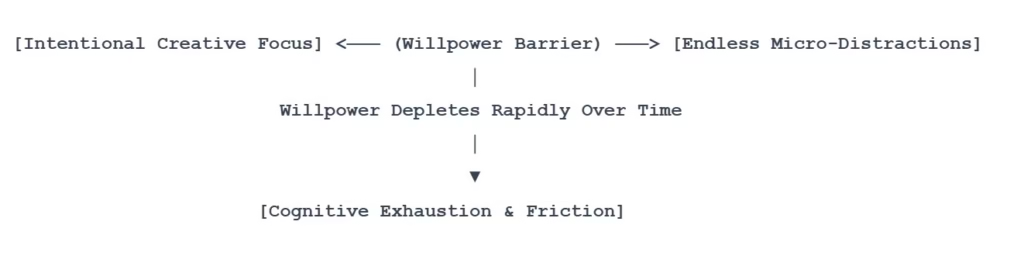
Our evolutionary biology is fundamentally unequipped to handle the hyper-engineered sensory inputs of the 2020s. Human attention is naturally drawn to novelty, sudden movements, and variable reward systems—traits that kept our ancestors alive but now leave us vulnerable to the notifications, tabs, and alerts that fill our workspaces.
Trying to achieve deep focus by relying solely on raw willpower is a losing battle. The solution isn’t to force yourself to resist distractions; it is to design a workspace where distractions are mechanically prevented from reaching your mind in the first place.
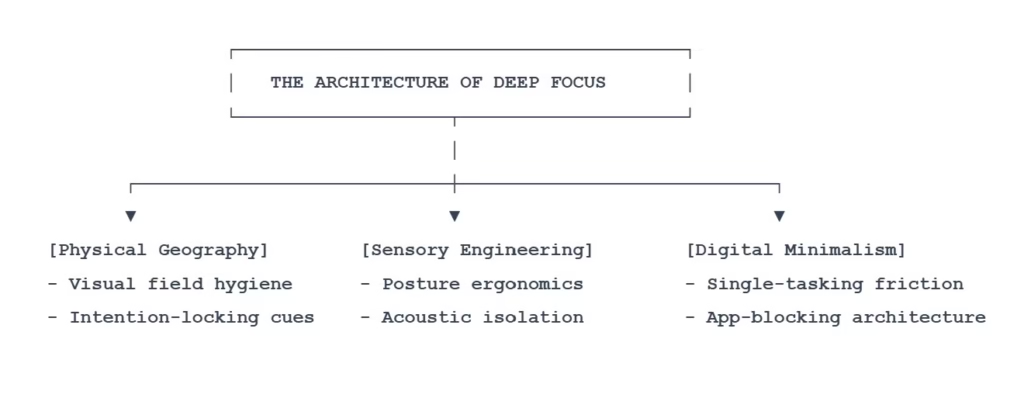
To build an unshakeable workflow, we must shift our perspective from psychology to architecture. We need to look past generic productivity advice and explore the foundational principles of environmental psychology, cognitive ergonomics, and spatial design.
By restructuring our immediate environments—both physical and digital—we can construct an intentional workspace that acts as a cognitive shield. This approach allows us to step out of a state of constant, exhausting reactivity and unlock a reliable, distraction-free environment for deep, meaningful work.
The Physical Geography of Attention: Visual Field Hygiene
The human visual processing system is an incredibly complex, resource-heavy cognitive machine. Our brains dedicate massive amounts of real estate to scanning our surroundings for changes, threats, and opportunities. Every object, piece of paper, charging cable, or stray coffee cup resting within your peripheral vision is not neutral; it is an active piece of visual background noise that your brain must spend energy ignoring.
This phenomenon is known as low-level visual salience. If your immediate workspace is cluttered with reminders of uncompleted chores, old sticky notes, or random tools, your attention is subtly divided before you even open your laptop.
True visual hygiene demands that your main work surface become a clean, intentional space dedicated only to the single deep task at hand.
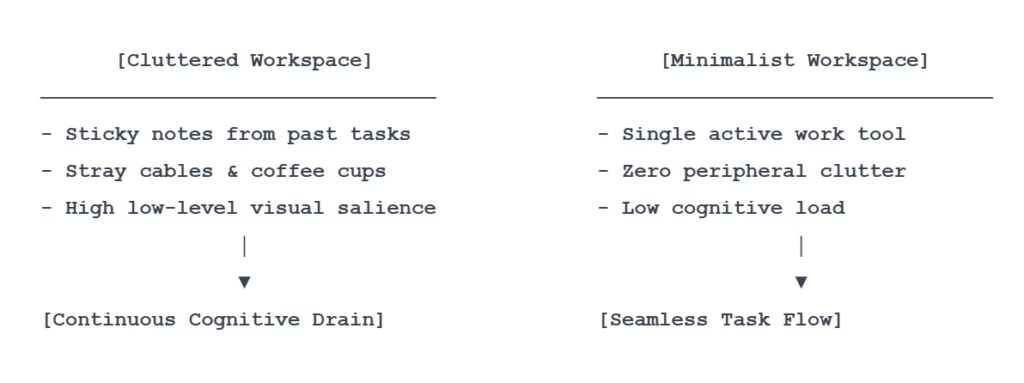
To optimize your environment, you must structure your space around an Intention-Locking Cue. When you sit down for a dedicated session of deep focus, your immediate visual field should contain only the physical tool required for that specific task. If you are writing, it should be your screen or your notebook. If you are reading, it should be the book. Everything else must be moved entirely out of your line of sight.
This clean physical separation creates an immediate cognitive boundary: it signals to your brain that you have crossed into an intentional zone where only one type of behavior is permitted.
Ergonomics and Acoustic Isolation
Focus is not a purely intellectual state; it is an active physical condition. Your brain cannot settle into prolonged periods of creative flow if your body is constantly sending background signals of physical discomfort, muscular tension, or sensory irritation to your nervous system. Many knowledge workers treat their desk and chair setups as minor issues, failing to realize that poor ergonomics act as a constant, subtle drain on their daily energy reserves.
The foundation of physical focus begins with posture ergonomics. When your spine is poorly supported, your body is forced to engage minor muscle groups continuously just to keep you upright. This hidden physical exertion leads to fatigue, shallow breathing, and a restless desire to fidget or abandon your desk.
By investing in an environment designed to support your natural skeletal alignment, you remove a major source of somatic friction. This allows your nervous system to drop its physical defenses and redirect that raw energy toward high-level cognitive processing.
Premium Ergonomic Engineering
Constructing a physical environment that protects your skeletal health is an essential investment for anyone seeking prolonged, sustainable focus.
- The Boss Office Products High-Performance Drafting Chair Widely regarded as a benchmark in cognitive ergonomics, this chair is engineered to adapt dynamically to your movements. By providing continuous lumbar support and encouraging natural posture adjustments, it eliminates the subtle physical discomfort that frequently disrupts deep focus sessions.
- Huanuo Dual Monitor Adjustable Stand A world-class tool for precise workstation customization. By allowing you to position your screens perfectly at eye level, it prevents neck strain and shoulder fatigue, ensuring your physical setup remains comfortable during long hours of creative work.
Alongside physical comfort, managing your acoustic environment is equally critical to protecting your focus. In a modern home office or shared workspace, sudden ambient noises—such as passing traffic, family activity, or remote construction—trigger an involuntary physiological alerting response.
Every time your attention is forced to track an unpredictable outside sound, your train of thought is interrupted, requiring significant time and effort to rebuild your cognitive momentum.
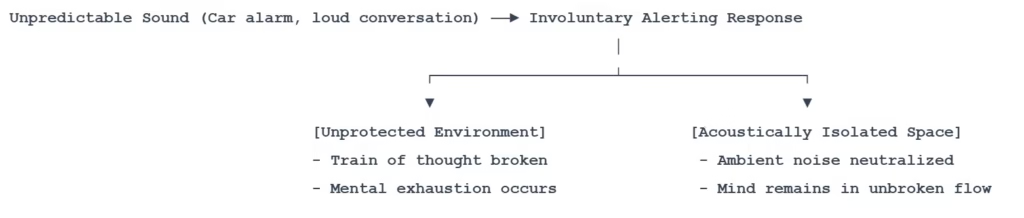
To protect your mind from these sensory disruptions, you must build an intentional acoustic barrier around your workspace. This can be achieved through a combination of high-quality physical sound-dampening materials and structured auditory tools.
Acoustic Isolation Tools
Neutralizing unpredictable ambient noise is a vital step toward safeguarding your mental energy from external disruption.
- The Neurowave™ Daily Brain Audio For professionals looking for a structured, scientifically grounded auditory environment, this digital soundscape program offers specialized acoustic frequencies designed to drown out distracting background conversations and guide the brain into a steady state of focused execution.
- The Bose QuietComfort Ultra Wireless Headphones An exceptional piece of sensory hardware that provides top-tier active noise cancellation. By instantly neutralizing low-frequency ambient drone, these headphones create an immediate, portable sensory sanctuary wherever you choose to work.
Digital Minimalism: Building Intentional Workspace Friction
Even if your physical desk is clean and your room is silent, the most dangerous threats to modern productivity are usually found inside your display. The modern operating system is a beautifully designed minefield of distractions. Our browsers contain access to the entirety of human knowledge alongside endless opportunities for entertainment, social validation, and administrative busyness.
To make matters worse, most productivity software is designed around the illusion of multitasking—a state of mind that cognitive scientists call continuous partial attention. When you jump back and forth between a creative document, an email tab, and a communication channel like Slack, you aren’t actually processing multiple tasks at once. Instead, your brain is rapidly switching its focus between different contexts.
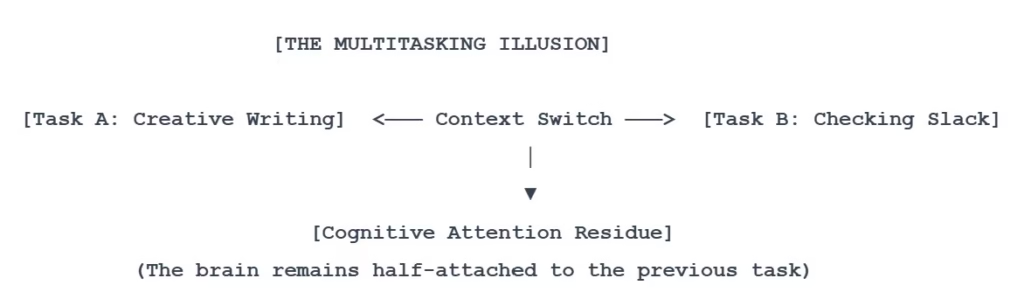
Every single time you switch your attention away from a deep task to check a notification, a phenomenon known as attention residue occurs. A portion of your active memory remains anchored to that message or email long after you close the tab. As you cycle through multiple apps, this mental residue builds up, leaving your mind feeling exhausted, scattered, and incapable of deep, analytical thought.
To protect your cognitive energy, you must move away from default settings and build structural friction directly into your digital environment:
- The Single-Tab Commandment: When working on a deep task, close every single browser tab that is not directly related to that piece of work. If you need to research a topic, complete the research in a designated block of time, close those tabs, and then open a separate window containing only your writing interface.
- The Nuclear Option for Notifications: Turn off all desktop notifications, badge icons, and pop-ups. If an application is important enough to check, it should be opened intentionally at a scheduled time, rather than allowing it to interrupt your workflow whenever it pleases.
- Architectural App Blocking: Do not rely on self-control to stay away from distracting websites during your work hours. Use hard digital barriers like application blockers to completely lock yourself out of social media, news sites, and personal email during your high-value deep work sessions.
The Chrono-Architecture of Focus: Time Blocking
Designing a distraction-free workspace involves more than just managing physical items and digital screens; it also requires managing how you structure your time. A workspace can quickly become chaotic if your day lacks clear boundaries.
Without a deliberate plan, your day naturally fills up with shallow, reactive tasks—answering non-urgent emails, attending unnecessary meetings, or constantly shifting between projects without making real progress on any of them.
To protect your deep work sessions, you need to use a structured approach called Chrono-Architecture. This means treating your schedule as a physical blueprint, organizing your day into distinct, non-overlapping blocks dedicated to specific types of cognitive tasks.
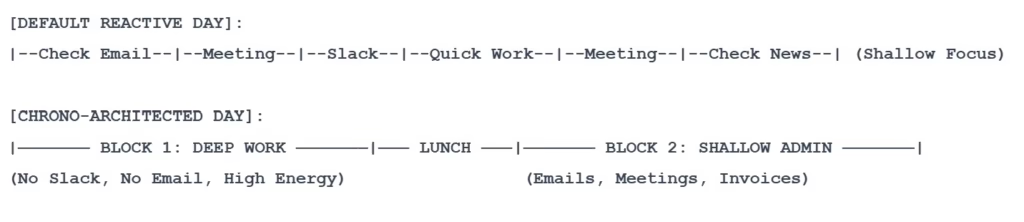
The core of this strategy requires separating your schedule into two distinct categories: Deep Work Blocks and Shallow Admin Blocks.
During a Deep Work Block—which should ideally be scheduled during your peak biological energy hours—your workspace must operate at maximum isolation. Your phone is moved to another room, your website blockers are turned on, and your attention is focused entirely on a single high-value project.
Conversely, during a Shallow Admin Block, you can loosen these restrictions. This is the designated time to open your communication apps, reply to messages, manage invoices, and handle routine administration.
By separating these tasks into their own dedicated time blocks, you protect your creative energy from being diluted by administrative busyness, allowing you to maintain deep, uninterrupted momentum when it matters most.
Deep Distinctions: The Two Schools of Spatial Focus
When it comes to building an optimal environment for focus, spatial design experts generally divide into two contrasting philosophies. Both schools of thought are highly effective, but they cater to completely different cognitive styles and types of tasks. Understanding these differences can help you customize your workspace to match your specific professional needs.
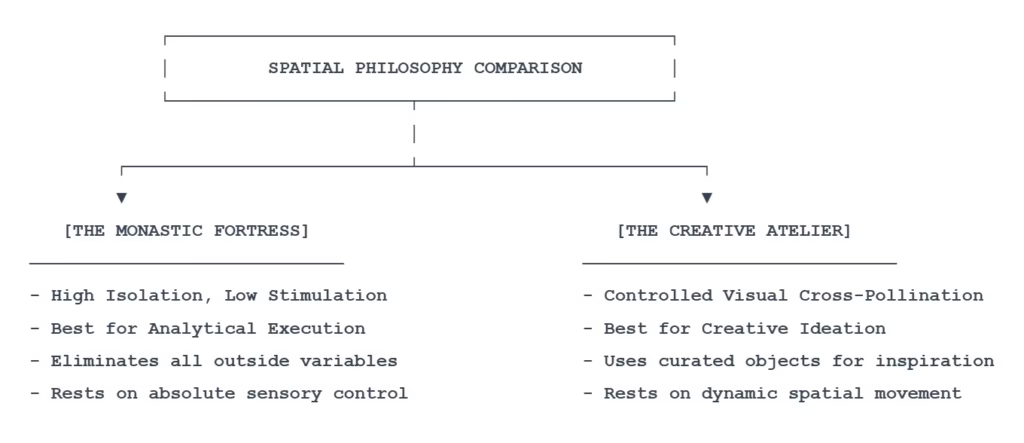
The Monastic Fortress vs. The Creative Atelier
The Monastic Fortress model is built on a philosophy of high isolation and low stimulation. This approach argues that any unnecessary physical object, color, or view represents a potential distraction that can disrupt your cognitive flow.
The ideal monastic space features a minimalist desk, neutral walls, hidden storage, and absolutely zero decoration. This highly controlled environment is designed for intense analytical execution, complex problem-solving, or deep writing—tasks where your attention needs to be directed entirely inward.
The Creative Atelier model, by contrast, relies on a philosophy of controlled visual cross-pollination. This approach recognizes that for creative ideation, innovation, and artistic work, absolute sensory deprivation can sometimes lead to mental stagnation.
The atelier workspace features a curated collection of inspiring physical objects—artbooks, material samples, historical items, or artistic prints—arranged in a neat, orderly fashion. This environment treats the physical space as an active collaborator, using structured visual cues to spark new insights and creative connections.
Absolute Sensory Control vs. Dynamic Spatial Movement
The Monastic Fortress is designed around a single, highly optimized station where you sit in the exact same position to maintain total control over your environment. It relies on consistency to help anchor your focus.
The Creative Atelier, however, encourages dynamic movement throughout the day. It structures the workspace into distinct functional zones: a sitting desk for focused computer execution, a separate armchair for deep reading, and a standing surface or whiteboard for brainstorming.
By physically moving to a different location when you change tasks, you provide your brain with a clear spatial cue that helps smooth the transition between different modes of thinking.
The Great Convergence: Design Metrics That Matter
Despite their differing styles, both design philosophies share several core principles. Whether you prefer a completely minimalist space or a richly detailed creative studio, both approaches rely on the same fundamental rules to keep your brain operating at its highest cognitive level.
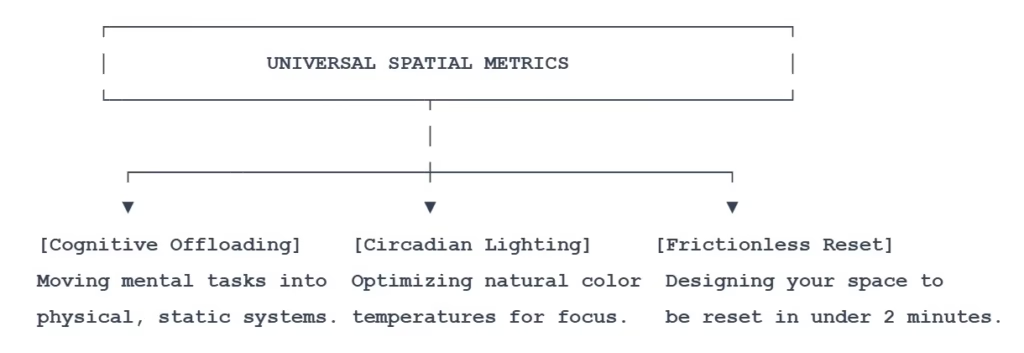
First, both design styles recognize the importance of Cognitive Offloading. This means taking administrative details, reminders, and daily lists out of your head and placing them into static, physical systems.
When you try to keep your daily schedule, project deadlines, and immediate to-do lists entirely in your short-term memory, you create a constant state of low-level mental strain.
Both monastic and creative spaces solve this by using clear, analog tools—like a physical desk calendar, a dedicated notebook, or a wall-mounted whiteboard. By mapping your tasks out on a physical surface, you free your brain from the burden of remembering what to do next, allowing you to dedicate your full mental energy to the work right in front of you.
Second, both approaches emphasize the critical role of Circadian Lighting. Your brain’s sleep-wake cycle, alertness levels, and metabolic energy are directly regulated by the color temperature and intensity of the light in your environment. Natural daylight, particularly the bright blue-toned light of the morning, signals your body to suppress melatonin production and increase focus and alertness.
A workspace that lacks natural light or relies entirely on dim, warm incandescent bulbs can leave you feeling sluggish and unfocused. Conversely, working under harsh, flickering fluorescent lights can cause eye strain and headaches.
Both philosophies place a premium on positioning your workspace near natural light sources or using smart, high-quality LED lighting that can adjust its color temperature to support your natural energy levels throughout the day.
Finally, both systems depend on a practice known as the Frictionless Reset. This is the habit of resetting your workspace to a clean, neutral state at the end of every single work session.
If you finish your day and leave your desk cluttered with open books, half-finished coffee mugs, and loose papers, you create immediate psychological friction for the next morning. When you sit down to start your work the following day, your first task will be cleaning up yesterday’s mess, which immediately drains your morning focus.
A well-designed workspace is structured so that it can be completely reset to neutral in less than two minutes. This ensures that every time you approach your desk, you are greeted by an inviting, distraction-free environment that makes it easy to jump straight into deep work.
Practical Synthesis: The 2-Minute Evening Reset Blueprint
To help turn these environmental concepts into a consistent daily habit, you can implement a simple, structured routine at the end of every workday. This process ensures your physical and digital spaces are reset to a clean state, removing any friction that might disrupt your focus the next morning.
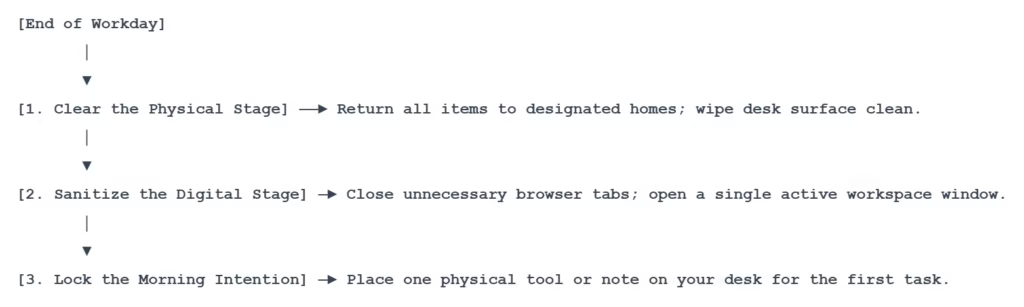
By taking just a few minutes each evening to prepare your environment, you eliminate the morning decision fatigue that often leads to procrastination. You ensure that when you sit down at your desk the next day, your workspace actively supports your focus rather than competing for your attention.
Environmental Metrics: A Scannable Reference Guide
This scannable reference guide breaks down the key environmental variables within your workspace, showing how to optimize each factor to protect your focus and reduce cognitive fatigue.
| Variable | The Distraction Trigger (Default) | The Focus Blueprint (Optimized) | Cognitive Purpose |
| Visual Field | Scattered clutter, old sticky notes, visible charging cables. | Single active tool; empty peripheral space; hidden wiring. | Minimizes low-level visual distractions; lowers cognitive load. |
| Acoustic Profile | Sudden ambient noises, background conversations, music with lyrics. | Active noise cancellation; structured, wordless soundscapes. | Prevents involuntary alerting responses; protects focus. |
| Digital Setup | Multiple open browser tabs; active desktop pop-ups and notifications. | Single active window; all notifications turned off; app blockers on. | Eliminates multitasking temptations and attention residue. |
| Lighting Quality | Dim, warm yellow lighting or harsh, flickering overhead fluorescents. | Positioned near natural daylight; adjustable high-CRI LED lighting. | Supports your natural circadian rhythms; reduces eye fatigue. |
| Somatic Comfort | Poorly adjusted chair; screens positioned below eye level. | Ergonomic task chair supporting natural spinal alignment; elevated monitors. | Eliminates the physical strain and discomfort that disrupts flow. |
| Task Management | Keeping project to-do lists entirely in your short-term memory. | Physical whiteboards, analog desk pads, or dedicated notebooks. | Uses cognitive offloading to free up mental processing power. |
Conclusion: Reclaiming Your Creative Sanctuary
Ultimately, a distraction-free workspace is not an expensive luxury reserved for a select few; it is a vital requirement for anyone who wants to produce high-value, meaningful work in a distracted world. It is an intentional environment built on the understanding that our willpower is limited, our attention is vulnerable, and our physical surroundings play a major role in shaping our internal focus.
You do not need an expensive office or a complete home remodel to begin applying these principles. The journey toward deep focus starts with small, deliberate adjustments: clearing a cluttered desk, disabling disruptive notifications, utilizing structured soundscapes, or setting up a simple evening routine to reset your space.
Your workspace is more than just a place where you open your laptop; it is a sanctuary for your mind, your ideas, and your creative potential. By taking control of your environment and designing it with intention, you stop acting as a passive target for modern digital distractions. You claim a quiet, reliable space where your attention is protected, your focus can flourish, and your best work can finally come to life.
The Holispectrahub Knowledge Commons
If this exploration of environmental architecture helped clarify your workflow, consider diving into our broader library of curated essays on psychology, mindfulness, and intentional living.
- The Art of Non-Attachment: Comparing Stoic Apatheia with Buddhist Upekkha Discover how ancient intellectual frameworks can help you build an internal shield against modern emotional stress and anxiety.
- The Alchemy of Time: A Deep Guide to Chrono-Architecture and Energy Mapping Explore how to synchronize your daily task list with your body’s natural circadian energy cycles to maximize your daily creative output.
Disclaimer: Holispectrahub is dedicated to publishing highly researched, value-first content. This essay features hand-selected resource links aimed at supporting your practice; we may earn a small affiliate commission at absolutely no additional cost to you if you choose to purchase through them.