
The Art of Non-Attachment: Comparing Stoic Apatheia with Buddhist Upekkha
We live in an age of competitive outrage and targeted psychological exhaustion. Every screen we touch, every notification we receive, and every algorithmic feed we scroll through is precisely engineered to extract an emotional reaction. Our focus is monetized, our anxieties are mapped, and our sense of self-worth is routinely tethered to moving targets: external validation, career metrics, financial fluctuations, and the turbulent opinions of a digital collective.
The immediate result is a quiet, pervasive Western epidemic of hyper-attachment. We find ourselves constantly clinging to specific outcomes, paralyzed by the fear of loss, and physically worn down by emotional swings between temporary euphoria and profound dissatisfaction. When our well-being relies on an unpredictable world, our internal state naturally mirrors that chaos.
Faced with this existential friction, modern culture frequently prescribes shallow forms of escapism disguised as wellness. We are told to numb our senses, download a superficial relaxation app, or practice toxic positivity by simply ignoring systemic problems. Yet these solutions offer little more than temporary relief; they treat the symptoms of over-attachment without touching its psychological roots.
To build true mental resilience, we need a deeper, more robust framework. We must look past contemporary self-help trends and return to the foundational thinkers of human history.
More than two thousand years ago, two highly sophisticated philosophical traditions emerged independently in completely different geographical regions: Stoicism in the bustling, civic-minded landscape of Hellenistic Athens, and Buddhism along the spiritual, contemplative rivers of the Indo-Gangetic Plain.
Despite their profound cultural, theological, and metaphysical differences, both traditions diagnosed the human condition identically: unregulated psychological attachment is the primary source of human suffering.
Even more striking is the convergence in their solutions. Both paths independently developed a specialized, highly disciplined mental state designed to shield the inner self from external chaos. The Stoics called this state Apatheia, while the early Buddhists named it Upekkha (उपेक्षा).
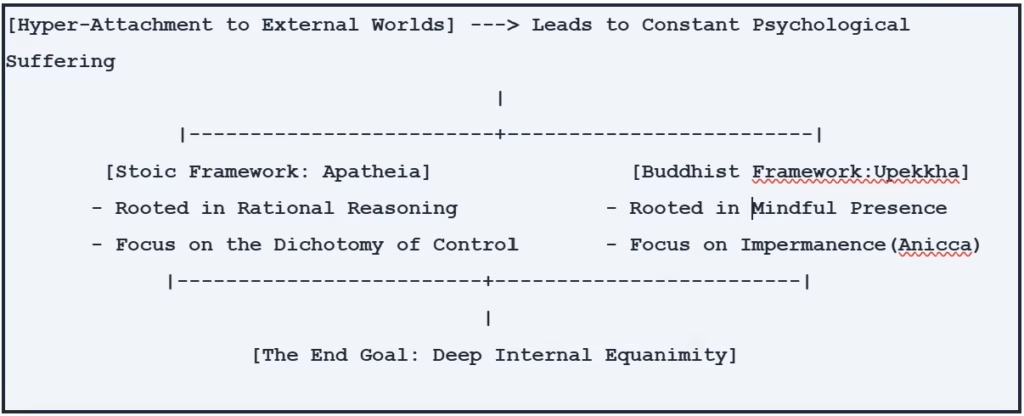
These two words are routinely mistranslated in the West as cold apathy, emotional deadness, or detached indifference. In reality, Apatheia and Upekkha represent vibrant, highly engaged states of psychological freedom. They do not turn a human being into an unfeeling robot; instead, they provide the radical emotional clarity needed to engage with a chaotic world without being broken by it.
Understanding the deep nuances, subtle contrasts, and practical intersections of these two conceptual systems reveals a timeless blueprint for personal resilience. By examining the structural machinery of both Stoic reason and Buddhist presence, we can learn to cultivate an unshakeable center capable of withstanding any modern storm.
The Anatomy of Stoic Apatheia: Freedom Through Reason
To understand the Hellenistic concept of Apatheia, one must first clear away the semantic debris that has accumulated around the word “stoic” over the last several centuries. In modern English, a lowercase “stoic” is someone who bites their lip, represses their grief, tolerates pain without complaint, and refuses to express any vulnerability. This modern stereotype is not only inaccurate, but it is also a recipe for psychological harm. The ancient Capital-S Stoics – such as Zeno of Citium, Cleanthes, Chrysippus, and later Roman practitioners like Seneca, Epictetus, and Marcus Aurelius -did not advocate for the repression of emotion. They advocated for the transformation of judgment.
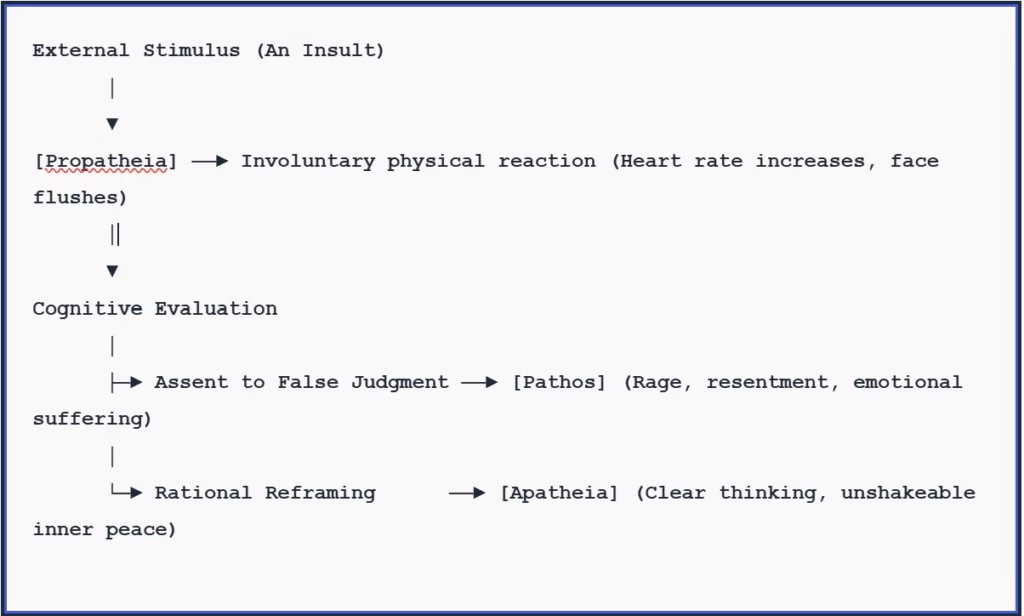
The Greek term Apatheia is literally formed by combining the privative prefix a – (“not” or “without”) with pathos (“passion,” “suffering,” or “deep emotional disturbance”). To the Stoic, a pathos is not a normal, instinctive human emotion like a flash of fear when a loud noise occurs or a wave of natural grief when a loved one dies. The Stoics explicitly classified these initial, involuntary physiological reactions as propatheiai (pre-passions). They recognized that your heart will race, your palms will sweat, and your stomach will drop when external chaos strikes; this is an unpreventable reality of human biology.
Instead, a true pathos – a destructive passion – only occurs when your conscious mind steps in, evaluates that initial physical reaction, and grants its cognitive assent to an irrational judgment.
For example, feeling a sudden flash of heat when someone insults you is a propatheia. But dwelling on that insult, deciding that a terrible injustice has occurred, and concluding that you must retaliate to preserve your honor is a pathos. This secondary step is an error in reasoning. It is an irrational desire that directly disrupts your inner peace.
Therefore, Apatheia is not the absence of feelings; it is the absolute freedom from emotional suffering brought about by clear, rational thinking.
The underlying intellectual framework that makes Apatheia possible is what Epictetus famously termed the Dichotomy of Control. In the opening sentence of his Enchiridion, he lays down the fundamental law of Stoic psychology:
“Some things are in our control and others not. Things in our control are opinion, pursuit, desire, aversion, and, in a word, whatever are our own actions. Things not in our control are body, property, reputation, command, and, in one word, whatever are not our own actions.”
To the Stoic, everything that falls outside the direct jurisdiction of your conscious will is classified as an adiaphora – an external variable that is fundamentally indifferent to the health of your soul. Your physical health, your bank account balance, the weather, economic downturns, political decisions, and how other people perceive you are all fundamentally outside your absolute control. They are variable, unpredictable, and subject to the whims of fate.
When you tie your emotional well-being to these external indifferents, you hand control of your mind over to the outside world. If you require praise to feel confident, you make yourself a slave to the opinions of others. If you require absolute financial certainty to feel secure, you become a hostage to market volatility.
The Stoic solution is to pull your desires and your fears back within the boundaries of your own mind. You learn to focus all of your energy on what you can control: your intentions, your judgments, your ethical actions, and how you choose to interpret external events.
To help ground this philosophy in your daily life, it can be incredibly useful to work through text translations that preserve the practical edge of these ideas. Rather than getting bogged down in dense academic commentaries, reading the direct personal journals of those who tested these principles under extreme pressure offers the best perspective.
Premium Philosophical Resources
If you want to see how these mental models operate under genuine stress, you should read the original personal journals of history’s most famous practicing Stoic:
- The Gregory Hays Translation of Marcus Aurelius’s Meditations (Amazon)This specific edition is highly recommended . Hays strips away archaic Victorian language and presents the Roman Emperor’s private mental exercises in crisp, clear, and punchy way for modern readers. It reads less like an outdated text and more like a direct psychological manual for self-mastery.
By internalizing the Dichotomy of Control, the Stoic achieves a state of calm clarity that transforms how they interact with the world. When an external disaster occurs—whether it is a medical diagnosis, a sudden business failure, or a public criticism—the mind trained in Apatheia immediately processes the event through a strict rational filter.
Instead of asking, “Why is this happening to me?” or declaring, “This is catastrophic,” the Stoic calmly observes the reality of the situation. They say to themselves: “This event is outside my control. My emotional suffering is not caused by the event itself, but by the negative judgment I am forming about it. I choose to drop that judgment.”
This shift in perspective completely disarms the destructive passion before it can take root in the mind. The result is an intentional mental space where you are no longer tossed about by the changing tides of daily life. You are finally free to act with logic, wisdom, and moral courage, regardless of how chaotic the world around you becomes.
The Mechanics of Buddhist Upekkha: The Radiance of Equanimity
Stepping from the philosophical porches of ancient Athens into the monastic forests of ancient India reveals a completely different vocabulary, yet a strikingly familiar psychological destination. In the Buddhist tradition, the supreme state of emotional balance is known in Pali as Upekkha (derived from the roots upa, meaning “over” or “beyond,” and iks, meaning “to look” or “to view”).
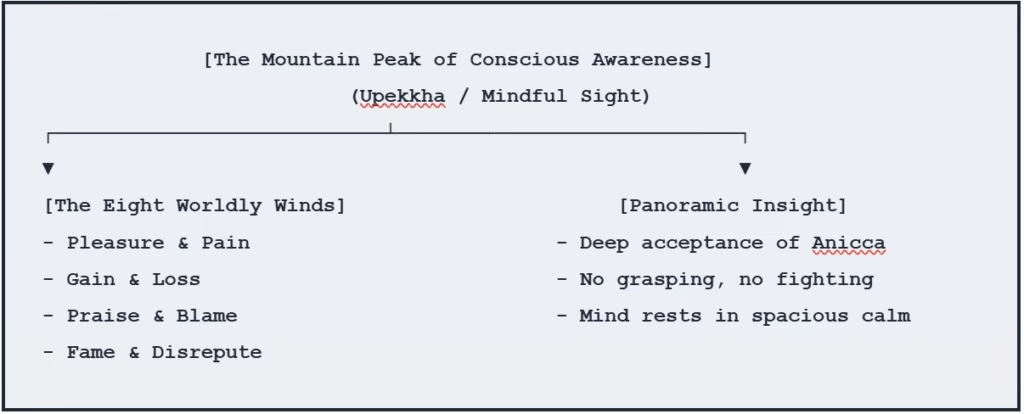
Literally translated, Upekkha means “to look over” or “to view from above.” It evokes the mental image of climbing to the peak of a high mountain and looking down at a stormy valley below. You are fully aware of the rain, the wind, and the lightning, but you are not swept away by them because you are standing securely on the high ground of broad awareness.
Within the architecture of Buddhist psychology, Upekkha is not a passive or empty state of mind. It is considered one of the Brahmaviharas – the four “Divine Abodes” or sublime states of heart that include Metta (loving-kindness), Karuna (compassion), and Mudita (sympathetic joy).
Crucially, Upekkha is the foundation that keeps the other three states stable. Without equanimity, love easily degrades into codependent attachment; compassion quickly turns into exhausting, overwhelming grief; and joy can transform into brief, superficial excitement. Upekkha provides the spacious, balanced container that allows you to care deeply about the world without being destroyed by its suffering.
To prevent misunderstandings, Buddhist texts emphasize the critical distinction between Upekkha and its “near enemy.” The near enemy of a virtue is a negative mental state that looks almost exactly like the virtue from the outside, but is driven by a completely toxic internal motivation.
The near enemy of true equanimity is cold indifference, apathy, or cynical withdrawal. It is the state of mind that says, “I don’t care what happens, none of it matters anyway.” This attitude is born from fear, spiritual exhaustion, or a defensive desire to wall oneself off from pain.
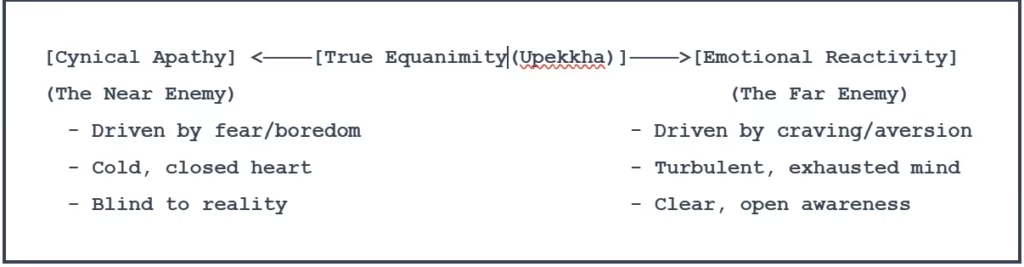
True Upekkha, by contrast, is completely alive, sensitive, and deeply attentive. It does not close its eyes to the world; it opens its heart completely to reality as it is, without needing to fight it, run from it, or grasp onto it.
The “far enemy” of equanimity is emotional reactivity – the constant oscillation between craving (Raga) and aversion (Dvesha). The reactive mind is always in a state of conflict with the present moment. If an experience is pleasant, we crave more of it and worry about when it will end. If an experience is unpleasant, we feel immediate aversion and frantically try to push it away. This endless struggle is the core mechanism of Dukkha (suffering or unsatisfactoriness).
Upekkha breaks this addictive loop through the deep, experiential realization of Anicca (the universal law of impermanence). Through the practice of insight meditation, you begin to observe that every single aspect of reality—every physical sensation, every thought, every emotion, every external circumstance—is a fluid, constantly changing process. It arises, stays for a brief moment, and eventually dissolves.
When you look at your life through this lens, you realize that trying to grasp onto a fleeting moment of pleasure or trying to fight a temporary moment of pain is as exhausting and futile as trying to grab a handful of smoke.
The mind trained in Upekkha learns to rest as an open, spacious witness. It allows the pleasant and the unpleasant to come and go naturally, without creating internal friction.
Moving this concept from an abstract academic idea into an experienced reality requires moving beyond reading into a structured, daily meditation habit. It demands that we actively train our nervous system to find a state of calm stillness.
Specialized Mindfulness Engineering
Moving your mind from intellectual analysis into actual psychological stillness requires structured training for your nervous system.
- The Brain Songwave Alignment Audio System For readers looking for a structured, tech-supported path to deep states of focus and mental clarity, this specific audio program utilizes precise audio frequencies to help settle a restless mind. It serves as an excellent modern tool to help quiet analytical background noise, paving the way for deep meditative presence and genuine equanimity.
- The Supermind Signal Audio Journey A premium, world-class 3D audio experience designed to guide the mind out of the fight-or-flight response. By using acoustic bi-aural patterns, it systematically slows down racing thoughts, making it significantly easier to practice spacious awareness and cultivate an unshakeable center amidst daily life.
When you train your mind to access this spacious inner calm, you develop a deep resilience against what early Buddhist discourses call the Eight Worldly Winds: pleasure and pain, gain and loss, praise and blame, fame and disrepute.
When these winds blow through your life, as they inevitably will, the mind resting in Upekkha does not break or capsize. Like a perfectly weighted ship in a stormy ocean, it simply sways with the waves, anchored securely by the deep understanding that this, too, shall pass.
Deep Distinctions: The Divergent Roots of Balance
While the outward expressions of Apatheia and Upekkha look almost identical—both presenting as a calm, unshakeable presence in the face of chaos—they are built on completely different philosophical foundations. They arrive at the same destination by traveling along entirely different intellectual highways. For an analytical Western reader, mapping these underlying differences is essential to fully understanding how and when to use each toolkit.
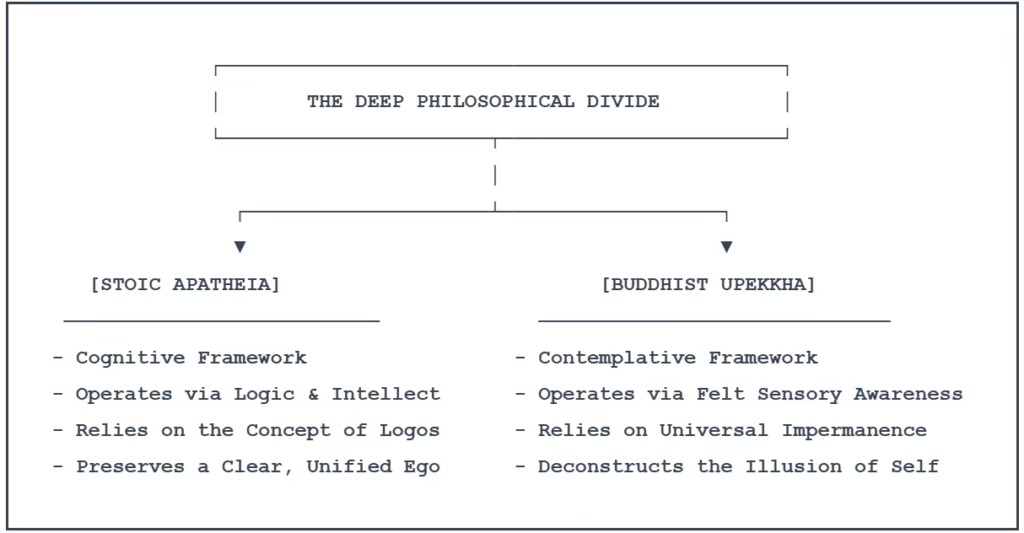
The Cognitive vs. The Contemplative
The most significant divergence lies in how these two states are achieved. Stoic Apatheia is a cognitive, intellect-driven framework. It operates primarily through the logical mind. When a Stoic encounters a stressful situation, they use active internal dialogue, rational definitions, and philosophical reframing. They reason their way out of suffering by analyzing their thoughts and correcting errors in judgment. It is a top-down approach: the rational intellect directly trains and commands the emotional responses.
Buddhist Upekkha, by contrast, is a contemplative, somatic framework. It operates primarily through non-judgmental, felt sensory awareness. Rather than trying to reason with an emotion or engage in an internal debate with an anxious thought, the meditator simply steps back and observes the raw physical sensations of the emotion in the body. They watch the tightness in the chest, the heat in the face, or the tension in the shoulders with a calm, curious presence.
By allowing these physical sensations to play out without trying to fix them or label them as “bad,” the emotion naturally burns through its energy and dissolves on its own. It is a bottom-up approach: pure awareness untangles the knots of the nervous system without needing to use analytical logic.
Teleology and the Cosmic Order vs. Radical Radical Impermanence
The underlying worldview that justifies these practices is also fundamentally different. Stoicism is deeply teleological, meaning it believes the universe is a rational, unified organism ordered by a divine cosmic intelligence known as the Logos. To the Stoic, everything that happens is an inevitable, necessary part of this grand cosmic design.
Therefore, resisting external reality is not just futile; it is an irrational rebellion against the natural order of the universe. Apatheia is an act of deep trust in the Logos. It is the realization that you cannot control the grand script of cosmic destiny, but you can control how beautifully you play your specific role.
Buddhism, on the other hand, rejects teleology and the concept of a grand cosmic design. It views reality not as a structured cosmic organism, but as an infinite, decentralized web of cause and effect known as Dependent Origination (Pratītyasamutpāda). There is no divine script, no inherent cosmic purpose, and no permanent foundation to the material world. Everything is caught in a perpetual cycle of change.
Upekkha is not an act of submission to a cosmic design; it is the natural consequence of seeing reality as it truly is – empty of permanent substance, radically fluid, and completely interconnected.
The Preservation of Self vs. The Dissolution of Self
Finally, these two paths differ sharply regarding the nature of the human ego. The Stoic framework is designed to build a strong, hyper-coherent, and ethically unified self. Apatheia creates a secure psychological fortress around your conscious will, protecting the purity of your soul from the corrupting influences of the outside world. It preserves a clear, healthy boundary between the rational observer and the external environment.
Buddhism takes the exact opposite approach, systematically deconstructing the very concept of a solid self. It asserts that the belief in a permanent, isolated ego—an independent “I”—is the ultimate illusion (Anatta) and the root cause of all psychological suffering.
Upekkha arises when you look so closely at your thoughts and emotions that you realize there is no permanent “thinker” hidden behind them. There is only a fluid stream of consciousness. When the illusion of an isolated self dissolves, the artificial boundary between “inner” and “outer” vanishes. The mind steps out of its defensive fortress and opens into a spacious sense of freedom.
The Great Convergence: Where Athens Meets India
When you look past their differing vocabularies and underlying worldviews, the practical alignments between Stoic Apatheia and Buddhist Upekkha are undeniable. It is a stunning example of cultural convergence: two ancient civilizations, separated by thousands of miles of rugged terrain and completely distinct languages, mapping the human mind and arriving at the exact same strategies for psychological liberation.
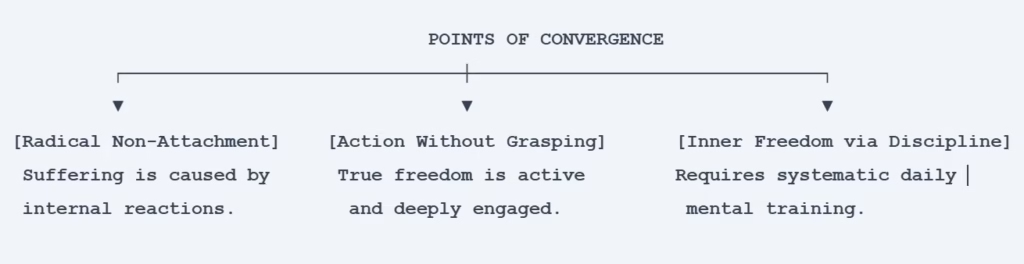
First and foremost, both traditions agree on a radical premise: your environment does not have the power to make you suffer. The external world can cause you physical pain, it can take away your property, and it can bring about difficult circumstances, but true psychological suffering (Pathos or Dukkha) only occurs when your mind reacts blindly, creating internal conflict. As Marcus Aurelius famously noted in his private journals:
“If you are distressed by anything external, the pain is not due to the thing itself, but to your estimate of it; and this you have the power to revoke at any moment.”
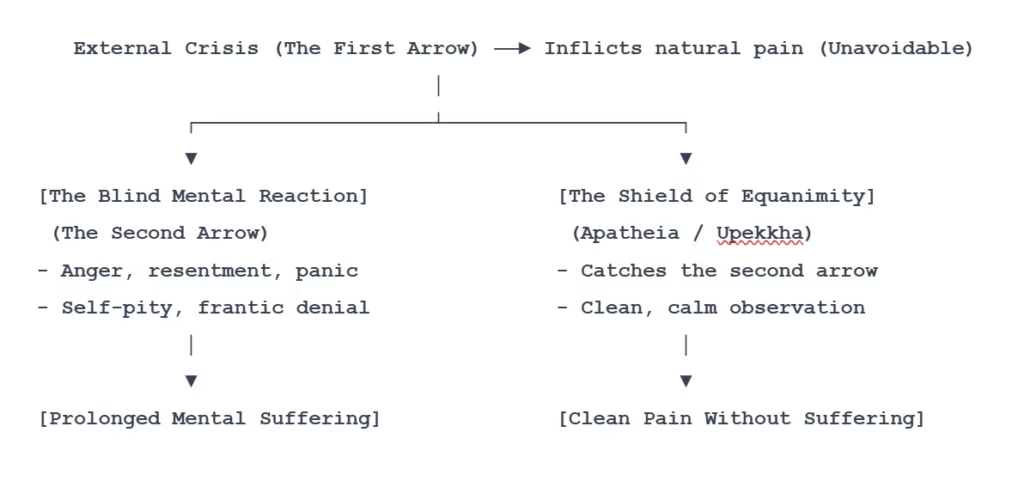
This insight is identical to the famous Buddhist parable of the Two Arrows. The Buddha explained that when a difficult event occurs, it is as if we are struck by an arrow. The first arrow is the raw physical reality: the sudden loss, the bodily injury, or the challenging external circumstance. This first arrow causes natural pain, and it is largely unavoidable.
However, our typical response is to immediately shoot a second arrow into ourselves. This second arrow is our mental reaction: the anger, the panic, the resentment, and the exhausting loop of self-pity (“Why me? This shouldn’t be happening!”). It is this second arrow that creates true psychological suffering. Both Apatheia and Upekkha are specialized mental shields designed to catch that second arrow before it can strike the heart.
Second, both paths explicitly state that non-attachment is not the same as passivity or social withdrawal. This is a critical point that modern critics frequently misunderstand. A person who practices Apatheia or Upekkha does not abandon their community to go sit idly on a beach or isolate themselves in a cave.
Marcus Aurelius was the ruler of the western world, directly commanding massive armies, managing complex state finances, and working tirelessly through public plagues and political betrayals. Yet he practiced Stoicism precisely to keep his mind steady so he could serve his people effectively.
Similarly, the historical Buddha spent forty-five years after his enlightenment walking thousands of miles across India, actively teaching communities, resolving intense political conflicts, and organizing large social groups.
True non-attachment does not mean you do not care about the world; it means you act without grasping onto outcomes. You commit yourself fully to doing the right thing, speaking truthfully, and helping others, but you do not base your internal peace on whether your efforts are immediately successful, appreciated, or praised. You separate your actions from the unpredictable reactions of the world. This approach allows you to act with deep focus, long-term sustainability, and true freedom, because you are no longer burning through energy worrying about things you cannot control.
Finally, both systems view emotional balance not as an accidental personality trait or a temporary mood, but as a highly disciplined skill that must be trained through daily practice. Neither Epictetus nor the Buddha promised that you could read a few lines of philosophy and instantly become enlightened or unshakeable.
They looked at the human mind as a complex piece of psychological machinery that requires constant calibration. Just as an athlete must train their body every single day to build physical strength, a philosopher must train their awareness every single morning and evening to build psychological resilience.
To make this systematic training approachable in our hectic modern schedules, we can benefit from organizing our study spaces with tools that encourage long-term focus and quiet contemplation.
Curated Environmental Tools
Designing a physical space that minimizes sensory distractions is incredibly helpful when training your mind to master emotional balance.
- Silensys E7 Active Noise Cancelling Headphones An exceptional tool for creating an immediate sensory sanctuary, whether you are working in a crowded city or meditating in a noisy environment. By filtering out external noise, they allow you to listen to focused audio programs or practice silence without constant outside interruption.
- The Mindful-Design Ergonomic Meditation Zafu Cushion A beautifully crafted, high-durability posture cushion that provides the exact structural support needed for prolonged sitting meditation. It helps keep your spine aligned and reduces physical discomfort, allowing your attention to remain fully focused on tracking your internal experiences rather than fighting body fatigue.
By combining consistent mental practice with an intentional environment, you can turn these ancient principles into a reliable daily habit. Over time, this systematic training rewires how your nervous system responds to stress, allowing you to transition smoothly from intellectual understanding to a living, daily experience of true equanimity.
Practical Synthesis: Building a Modern Everyday Blueprint
How do we actually integrate these ancient concepts into our fast-paced modern lives? How do we use the sharp, logical razor of Stoic reason alongside the wide, open ocean of Buddhist mindfulness when dealing with a demanding corporate culture, an overwhelming news cycle, or personal relationship challenges?
The answer lies in building a practical, structured daily routine that synthesizes the best elements of both traditions into an actionable mental blueprint.
Step 1: The Morning Preview (The Stoic Cognitive Filter)
Before you check your phone, open your email, or engage with the outside world, take five minutes to run your mind through a proactive cognitive rehearsal. This exercise is directly modeled on Marcus Aurelius’s famous morning reminder to himself.
Sit quietly and preview the day ahead. Identify the specific meetings, tasks, or interactions that are likely to trigger your stress, impatience, or anxiety. Run through this clear, internal script:
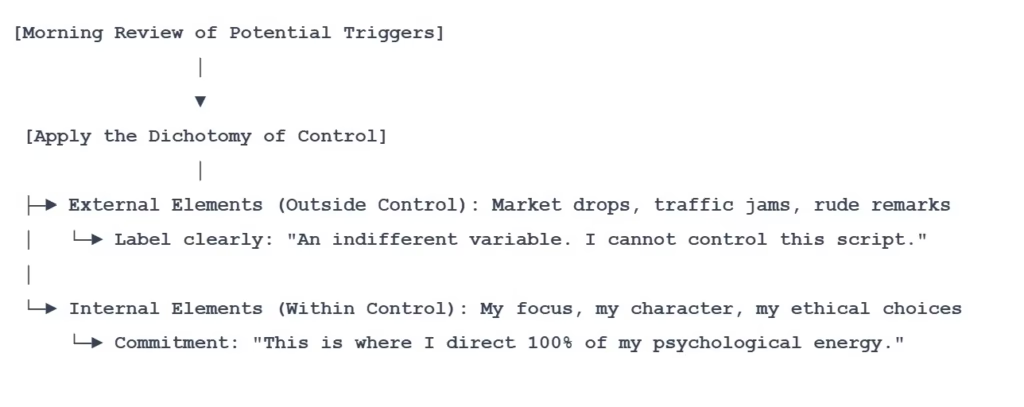
By explicitly mapping out these challenges before they happen, you remove the element of surprise that usually fuels intense emotional reactions. You pre-program your mind with rational responses, ensuring that when a difficult situation arises, you meet it with prepared wisdom rather than blind reactivity.
Step 2: The Mid-Day Pause (The Buddhist Somatic Scan)
As you move through the frantic rush of your afternoon, your morning preparation will inevitably face real-world friction. A project deadline will shift unexpectedly, a colleague will make a thoughtless comment, or an unexpected financial expense will surface.
The moment you feel the initial physical sting of a stress trigger—that sudden tightness in your chest, the clenching of your jaw, or a sharp spike in your heart rate—stop moving. Do not respond to the email, do not speak a word, and do not make a decision. Step away from your desk if possible and implement a three-breath somatic scan:
- The First Breath: Direct your entire attention away from the external problem and bring it deep into your physical body. Locate exactly where the stress is trying to anchor itself in your muscles or nervous system.
- The Second Breath: Observe the physical sensation with absolute curiosity and zero judgment. Do not try to make the sensation go away, do not panic, and do not analyze the story behind it. Simply label it quietly: “There is heat. There is pressure. This is a passing bodily wave.”
- The Third Breath: Consciously drop your false judgments. Remind yourself that this internal sensation is completely temporary—it has arisen, it is staying for a moment, and it will eventually pass on its own if you stop feeding it with angry thoughts. Let your mind relax into the wide, accommodating space of raw awareness.
This brief pause breaks the automated link between a stressful stimulus and a reactive response. It allows you to process the event through clean presence, preventing a momentary challenge from snowballing into hours of exhausting mental frustration.
Step 3: The Evening Audit (The Rational Review)
At the end of the day, before you go to sleep, close the loop on your mental training by performing a completely honest, objective review of your behavior. Take out a journal and answer three simple questions derived from ancient evening exercises:
- Where did my emotional balance hold steady today? Acknowledge the specific moments where you successfully applied the Dichotomy of Control or preserved a calm presence under pressure. Celebrate these moments as genuine progress in your mental training.
- Where did my attachment trip me up? Identify exactly where you lost your temper, allowed anxiety to take over, or fell back into blind reactivity. Be precise: did you tie your peace of mind to someone else’s approval, or get caught up fighting an unchangeable circumstance?
- How can I handle that situation with greater wisdom next time? Re-script the failure. Re-imagine the difficult scenario playing out, but visualize yourself handling it with perfect Stoic reason or deep Buddhist presence.
This evening audit ensures that your daily challenges are systematically transformed into valuable lessons for your personal growth. It prevents you from sweeping mistakes under the rug, ensuring that you wake up the next morning with a sharper focus, a lighter heart, and a more resilient center.
Comparative Matrix: A Scannable Reference Guide
To help summarize everything we have discussed, this scannable reference matrix maps out the core elements of both systems side-by-side. Use this guide whenever you need a quick reminder of how to apply each philosophical toolkit to your life.
| Dimension | Stoic Apatheia | Buddhist Upekkha |
| Etymological Root | A- (without) + Pathos (destructive passion/irrational emotional suffering). | Upa (over/beyond) + Iks (to view/look). |
| Core Translation | Freedom from destructive passions; absolute cognitive clarity. | Equanimity; panoramic, even-minded psychological balance. |
| Primary Mechanism | The Dichotomy of Control: Categorizing reality into what is within your will vs. what is not. | Mindfulness of Impermanence (Anicca): Witnessing all things rise and fall without grasping. |
| Method of Practice | Top-down logical analysis, Socratic dialogue, and cognitive reframing. | Bottom-up sensory observation, insight meditation, and somatic body tracking. |
| The Underlying Worldview | A rational, purposeful universe ordered by a single divine intelligence (Logos). | A fluid, decentralized web of constant cause and effect (Dependent Origination). |
| The Target Deception | The false belief that external things (Adiaphora) have the power to harm your character. | The deep illusion of a solid, permanent, and isolated self (Anatta). |
| The “Near Enemy” | Lowercase “stoicism”—cold, defensive emotional repression or vulnerability denial. | Cynical apathy, cold indifference, or nihilistic withdrawal from the world. |
| Engagement Model | Deeply committed to civic duty, cosmopolitan service, and leadership. | Deeply rooted in universal compassion (Karuna) and loving-kindness (Metta). |
Conclusion: Finding Stillness in the Modern Storm
Ultimately, Apatheia and Upekkha are not outdated museum pieces from dead civilizations. They are highly practical, battle-tested mental toolkits designed for the exact same human condition we face today. They remind us that while we cannot control the wild movements of the modern world, we possess absolute sovereignty over how our minds choose to respond.
You do not have to choose between the logical clarity of the Stoic or the deep presence of the Buddhist. By synthesizing both paths, you equip yourself with an incredibly versatile framework for internal resilience.
When your analytical mind needs a sharp, practical rule to navigate a chaotic corporate environment, you can deploy the strict boundaries of the Dichotomy of Control. When your over-taxed nervous system needs to step away from analytical thinking and simply find rest, you can open yourself to the wide, accommodating ocean of mindful equanimity.
True freedom is not found by running away to an isolated paradise, nor is it found by building an unfeeling wall around your heart. It is found by cultivating an unshakeable center right here in the midst of your daily life—a calm inner sanctuary that no algorithm can manipulate, no criticism can pierce, and no external crisis can diminish. By committing to this systematic daily training, you step out of the cycle of blind reactivity and claim the ultimate human luxury: a mind that is genuinely, undeniably free.
The Holispectrahub Knowledge Commons
If this deep philosophical exploration brought value to your journey, consider diving into our broader library of curated content. Explore our companion essays on psychological resilience, historical profiles of ancient wisdom traditions, and practical guides for mindful living.
- The Architecture of Focus: Designing a Distraction-Free Workspace Learn how to pair ancient mental models with modern design principles to build a physical environment that protects your deep focus and supports long-term mental clarity.
- The Anatomy of the Shadow: A Complete Guide to Jungian Psychology Discover how Carl Jung’s framework of the personal unconscious directly mirrors ancient esoteric and spiritual maps of the human mind.
Disclaimer: Holispectrahub is dedicated to publishing highly researched, value-first content. This essay features hand-selected resource links aimed at supporting your practice; we may earn a small affiliate commission at absolutely no additional cost to you if you choose to purchase through them.