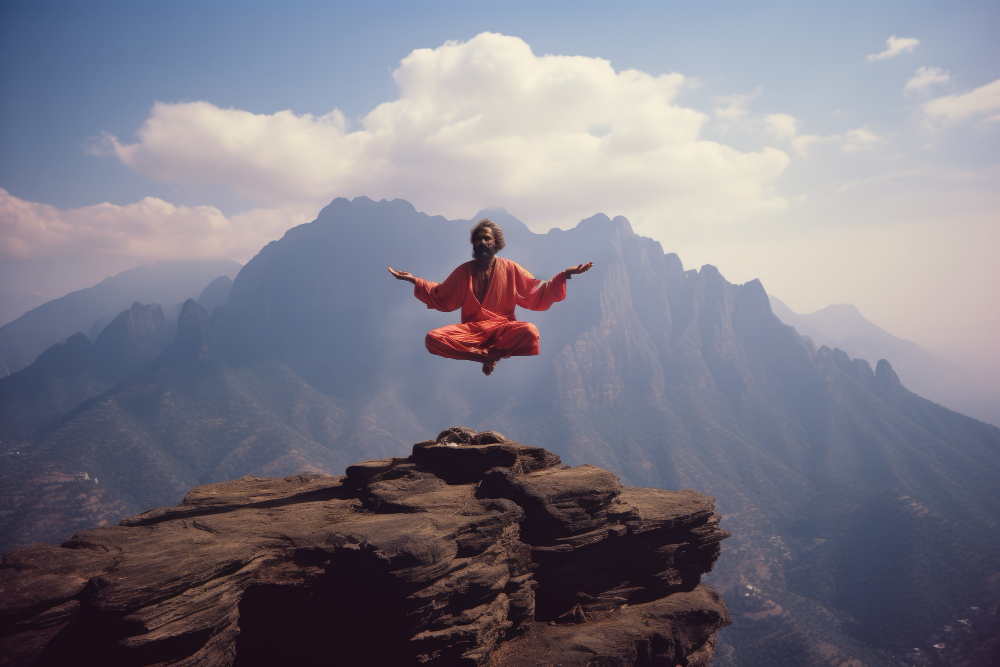
Spiritual Meditation: The Ancient Secret to Releasing Stress and Discovering Lasting Peace

Table of Contents
Your heart is pounding. Not from excitement, but from a relentless, low-grade dread. Your mind is a browser with too many tabs open, each one a worry, a deadline, a responsibility screaming for attention. You’ve tried the breathing exercises, the yoga classes, the apps that promise calm. For a moment, it works. The wave of anxiety recedes. But it always comes back, because the ocean of your life—the deadlines, the emails, the news cycles, the internal pressure to do and be more—is still there.
You’re not managing stress; you’re managing symptoms. You’re putting a band-aid on a wound that needs deeper healing.
What if there was a way to not just manage stress, but to fundamentally change your relationship to it? What if you could discover a place inside you that stress cannot touch? A peace that isn’t dependent on external circumstances being perfect? A silence that remains unbroken even when the world is in chaos?
This is the promise not of relaxation, but of awakening. This is the ancient secret of spiritual meditation.
Unlike secular mindfulness, which often aims to calm the mind for the world, spiritual meditation aims to calm the mind from the world, to discover the timeless, unchanging awareness that lies beneath it. Stress release in this context is not the goal; it is the most natural and inevitable byproduct of remembering who you truly are.
In this guide, we will journey far beyond simple techniques. We will explore the profound philosophy of why we suffer, the science that confirms what mystics have always known, and the powerful, transformative practices that can guide you from a life of reaction to one of profound, unshakable peace. This is not about adding another task to your to-do list. It is about coming home to yourself.
The Philosophy of Stress and Silence
Why You’re Really Stressed: It’s Not What You Think
Let’s begin with a provocative statement: Your job isn’t stressful. Your thoughts about your job are stressful.
The deadline itself is a date on a calendar. The email is a collection of data on a server. The traffic jam is a collection of stationary cars. They are neutral events. What isn’t neutral is the interpretation your mind places on them:
- “I’m going to fail.”
- “My boss is going to be furious.”
- “I’m going to be late and everyone will think I’m irresponsible.”
- “I’m trapped.”
This is the simple but powerful equation: Event + Interpretation = Stress Response.
The pounding heart, the clenched jaw, the foggy thinking—these are all biological reactions to the perceived threat generated by your own mind. This is the work of what we can call the egoic mind, or the “small self.” This part of your consciousness is not your enemy; it’s a survival mechanism that has run amok. It has one primary function: to protect its idea of “you.”
It does this by constantly living in the past and future. It re-runs past mistakes (regret, shame) and pre-runs future scenarios (anxiety, fear). It thrives on storytelling, creating a narrative of a fragile, separate “me” that is under constant threat from a hostile world. It believes its safety lies in controlling the uncontrollable: other people’s opinions, world events, the flow of time itself.
This is exhausting. This is the engine of stress.
But at its absolute core, the root of stress is even deeper than a noisy mind. It is a sense of separation. The egoic mind operates from the fundamental belief that “I am here, and everything else is out there.” This feeling of being a isolated island creates a primal vulnerability. We feel we must constantly defend, acquire, and achieve to feel safe and whole.
Spiritual meditation addresses this problem at its root. It is not about creating a better, more relaxed story for the ego. It is about awakening to the truth that you are not the ego at all. You are the vast, aware, peaceful consciousness in which the ego and its dramas arise. You are not the wave frantically trying to control the ocean; you are the ocean itself, deep, still, and unshakable. When this shift happens, stress doesn’t get managed; it loses its foundation and simply dissolves.
Spiritual Meditation vs. Secular Mindfulness: A Crucial Difference
This is a critical distinction to understand, as it shapes the entire intention and outcome of your practice.
Secular Mindfulness has become immensely popular for excellent reasons. Its primary goals are practical and psychological:
- Goal: To reduce stress, improve focus, regulate emotions, and enhance overall well-being within the context of your current life.
- Method: It primarily involves paying attention to the present moment—often the breath, bodily sensations, or sounds—without judgment.
- Outcome: You become better at managing your mind. You learn to observe stressful thoughts without being completely hijacked by them. It’s like learning to calm the waves on the surface of the ocean.
Spiritual Meditation, while it includes and transcends mindfulness, has a different ultimate aim:
- Goal: Self-realization, awakening, or enlightenment. The discovery of your true nature as pure awareness (Consciousness, Spirit, Atman, Buddha-nature).
- Method: It uses focused attention (on a mantra, the breath, a question) as a tool to not just calm the mind, but to pierce through the content of the mind (thoughts, emotions, sensations) to realize the aware space in which all content appears.
- Outcome: Stress release occurs not because you’ve managed your thoughts, but because you’ve realized you are not your thoughts. You are the silent, spacious witness. The wave realizes it is the ocean, and the struggle ends. The root of separation is severed.
| Aspect | Secular Mindfulness | Spiritual Meditation |
|---|---|---|
| Primary Goal | Manage stress, improve focus, enhance well-being. | Self-realization, awakening, liberation (Moksha). |
| View of Thoughts | Thoughts are mental events to be observed non-judgmentally. | Thoughts are objects in consciousness; the key is to discover the subject (Awareness itself). |
| Outcome for Stress | Management: You get better at handling stressful thoughts. | Dissolution: The identification with the stressful “thinker” falls away. |
| Analogy | Calming the waves on the surface of the ocean. | Discovering the depth and stillness of the ocean itself. |
Both paths are valuable, but spiritual meditation offers a more fundamental and permanent resolution to suffering by addressing its existential core.
The Science of Soul and Synapse
How Spiritual Meditation Rewires Your Brain for Peace
For centuries, the benefits of meditation were confined to subjective experience. Today, modern neuroscience provides a breathtaking window into how this ancient practice physically alters the very structure and function of our brains, moving us from a state of reaction to one of peace.
It all begins with the autonomic nervous system (ANS), the control system for your fight-or-flight and rest-and-digest functions.
- The Sympathetic Nervous System is your accelerator. It’s vital for survival, flooding your body with cortisol and adrenaline to face immediate danger.
- The Parasympathetic Nervous System is your brake. It promotes relaxation, digestion, healing, and a sense of calm.
Chronic stress is essentially a stuck accelerator. Spiritual meditation is the practice of gently and consistently applying the brake, teaching your body that it is safe to rest.
This shift is possible due to neuroplasticity, the brain’s remarkable ability to reorganize itself by forming new neural connections throughout life. The old adage “neurons that fire together, wire together” means that whatever we practice consistently becomes the default pathway in our brain. By practicing focused attention and compassionate awareness, we strengthen the circuits for peace and weaken the circuits for panic.
Brain imaging studies (fMRI and EEG) show how spiritual meditation creates tangible change in key areas:
- Prefrontal Cortex (PFC): This is the CEO of your brain, responsible for rational decision-making, focus, and dampening the amygdala’s alarm bells. Meditation thickens the grey matter in the PFC, enhancing your ability to pause before reacting and choose a more thoughtful response.
- Amygdala: This is your brain’s ancient alarm system, triggering fear and anxiety. Studies show that meditation literally shrinks the amygdala. A smaller, less active amygdala means you are less reactive to stressors. A loud noise might make you jump, but it won’t send you into a prolonged tailspin of anxiety.
- Default Mode Network (DMN): This is perhaps the most fascinating discovery. The DMN is a network of brain regions that is most active when you’re not focused on the outside world—when your mind is wandering, ruminating about the past, worrying about the future, and thinking about yourself. It’s the physical correlate of the “egoic mind” and its constant storytelling.
Spiritual meditation is one of the most powerful tools for quieting the DMN. This quieting is directly correlated with the subjective experience described by meditators for millennia: the fading of the sense of a separate “self,” the ending of internal narration, and the emergence of a profound peace and connectedness. Science is now confirming the experience of ego dissolution that is the hallmark of spiritual awakening.
The message is clear: the peace you seek through spiritual practice is not a metaphorical concept. It is a biological state that you can cultivate, one conscious breath at a time.
A Toolkit for Transformation: Spiritual Meditation Practices
Theory and science are foundational, but transformation happens through practice. Here are five powerful spiritual meditation techniques. I encourage you to explore them with a gentle, curious attitude. Find one that resonates with you and commit to it for a period of time.
1. Mantra Meditation: The Power of Sacred Sound
The Philosophy: A mantra is not a positive affirmation. It is a sacred sound, syllable, or phrase infused with vibrational potency. In traditions like Hinduism and Buddhism, mantras are seen as sonic representations of divine energy. The repetition of the mantra (“man-tra” means “instrument of the mind”) acts as a vehicle to transport the practitioner beyond the chatter of the intellect into a state of pure awareness. The sound itself, through its vibration, harmonizes the body and mind.
The Practice:
- Find a comfortable seated position with your spine erect.
- Close your eyes and take a few deep, natural breaths to settle in.
- Choose a mantra. Traditional options include “Om” (the primordial sound), “So Hum” (meaning “I am That”), or “Ram.” You can also use a neutral word like “peace” or “love.” The specific word is less important than the intention behind it.
- Begin to repeat the mantra silently in your mind. Don’t force it or concentrate fiercely. Let it arise effortlessly, like a gentle whisper from within.
- Your mind will wander. This is not a mistake; it is the practice. The moment you realize you’ve been hooked by a thought, gently and without judgment, return to the repetition of the mantra.
- Continue for your chosen period (start with 10-15 minutes).
Benefits for Stress: The mantra acts as an anchor, constantly pulling you away from stressful thought loops and into a rhythmic, calming, internal vibration. It gives the thinking mind a simple task, allowing it to rest and become quiet.
2. Self-Inquiry (Atma Vichara): The Direct Path to “I”
The Philosophy: This profound practice stems from the teachings of the Indian sage Ramana Maharshi. It is the most direct method for eradicating stress at its root. The logic is impeccable: Stress requires a stresser—a “me” who feels threatened. If you investigate and discover the true nature of this “me,” the foundation of stress collapses. The question “Who am I?” is not meant to elicit a philosophical answer but to direct your attention away from objects of consciousness (thoughts, feelings) and back to the subject, the pure I-Am-ness itself.
The Practice:
- Sit quietly and allow your mind to settle slightly.
- When a stressful thought or feeling arises—for example, “I am so anxious about this presentation”—use it as fuel for your inquiry.
- Ask yourself: “Who is anxious?” or “To whom does this anxiety arise?”
- Don’t try to answer intellectually. Simply pose the question and sink your attention back into the source of the “I” that claims ownership of the feeling. Feel back into the sense of being, of presence, that is prior to the thought.
- You might get answers like “Me!” or “My mind.” See these too as thoughts and ask again: “Who is this ‘me’ that is anxious?” “Who owns this mind?”
- Continue this gentle, persistent turning inward. You are not seeking an answer, but abiding as the awareness that is always here.
Benefits for Stress: This practice does not manage stress; it deconstructs it. By failing to find a solid, separate entity called “me” that can be threatened, anxiety and fear simply have nowhere to land. They arise and pass away in the vast space of your own awareness, without causing a ripple.
3. Breath Awareness (Pranayama): Riding the Wave of Life Force
The Philosophy: In Sanskrit, Prana means life force energy, and Yama means control. Pranayama is the conscious direction of this energy through the breath. The breath is the bridge between the conscious and the unconscious, between the body and the mind. It is the only autonomic function we can also control voluntarily. By becoming master of the breath, we become master of our inner state. A calm, steady breath directly creates a calm, steady mind.
The Practice (Diaphragmatic Breathing):
- Sit or lie down comfortably. Place one hand on your chest and the other on your belly.
- Close your eyes and breathe naturally for a minute, observing.
- Now, begin to inhale slowly and deeply through your nose, feeling your belly expand and push your hand outward. Your chest should move very little.
- Exhale slowly through your nose or mouth, feeling your belly fall inward.
- Focus all your attention on the physical sensations of the breath: the cool air entering your nostrils, the rise and fall of your abdomen, the slight pause between breaths.
- When your mind wanders, gently return your focus to the breath. You are not controlling it forcefully, but simply riding its wave with full awareness.
A Simple Ratio Practice (Box Breathing):
- Inhale for a count of 4.
- Hold the breath for a count of 4.
- Exhale for a count of 4.
- Hold the breath out for a count of 4.
- Repeat this cycle for several minutes.
Benefits for Stress: This is the most direct lever to pull to activate the parasympathetic nervous system. It lowers heart rate and blood pressure instantly. It grounds you firmly in the present moment, the only place where stress cannot exist.
4. Loving-Kindness (Metta): Dissolving Barriers with Compassion
The Philosophy: Metta meditation is the systematic cultivation of unconditional friendliness and compassion. Much of our stress arises from interpersonal conflict, resentment, and a feeling of separation from others. Metta practice directly melts these barriers by recognizing the shared desire for happiness and freedom from suffering in all beings. It heals the heart and expands your sense of self to include others.
The Practice:
- Sit comfortably and take a few calming breaths.
- Begin by directing phrases of well-wishing to yourself. Feel their meaning. Repeat slowly:
- May I be happy. May I be peaceful. May I be safe. May I be free from suffering.
- After a few minutes, bring to mind a “benefactor”—someone who has been deeply kind to you. Direct the same phrases to them: May you be happy…
- Next, bring to mind a dear friend.
- Then, a neutral person—someone you see but don’t really know (e.g., a barista, a neighbor).
- Now, the difficult part: bring to mind a difficult person in your life. This is not about condoning their actions, but about recognizing their shared humanity and wishing them peace. This releases you from the prison of resentment.
- Finally, expand your awareness to include all beings everywhere: May all beings be happy. May all beings be free.
Benefits for Stress: This practice directly counteracts the isolation and anger that are major sources of stress. It replaces feelings of hostility with warmth, and separation with connection. Releasing resentment is one of the most liberating things you can do for your own mental peace.
5. Mindfulness of Thoughts: Becoming the Sky, Not the Storm
The Philosophy: This is the essence of the spiritual application of mindfulness. The goal is not to stop thoughts but to change your relationship to them. You learn to see thoughts not as “yours” or as “truth,” but as impersonal events that appear and disappear in the vast space of your awareness. You are not the storm of thoughts; you are the sky that holds the storm. This “de-identification” is the source of ultimate freedom.
The Practice:
- Sit in meditation.
- Instead of focusing on the breath or a mantra, allow your attention to rest on the flow of thoughts itself.
- Adopt the attitude of a curious scientist or a silent witness. Watch thoughts arise, play out, and pass away.
- Use mental labels to create distance: “Thinking…”, “Worrying…”, “Remembering…”
- Notice the space between thoughts. That silence is your true home.
- You can imagine thoughts as:
- Clouds passing in the sky (you are the sky).
- Leaves floating down a stream (you are the riverbank).
- Trains passing at a station (you are the station; you don’t have to get on every train).
Benefits for Stress: A stressful thought arises, but it loses all its power because you no longer fuse with it. You see it as a temporary mental weather pattern. This breaks the cycle of “stressful thought -> stressful reaction -> more stressful thoughts” instantly. You realize you are the awareness behind the thought, and in that realization, you are free.
Weaving Practice into Life
From the Cushion to the Chaos: Living a Meditative Life
The true measure of your practice is not the peace you feel during a quiet meditation session; it’s the peace you can maintain when your computer crashes, your flight is canceled, or your child is having a meltdown. The goal is to make all of life your meditation.
Consistency Over Duration: A non-negotiable, daily practice is far more powerful than occasional long sessions. It’s like training a muscle. Five to twenty minutes every single day will transform your life more than a two-hour session once a month. The daily repetition rewires your neural pathways and keeps the memory of awareness fresh.
Create a Ritual: Designate a specific time and place for your practice. It doesn’t need to be an elaborate altar—a quiet corner with a cushion will do. The ritual itself signals to your mind and body that it is time to shift gears.
Informal Meditation: This is where the magic truly unfolds. Practice bringing mindful awareness into your everyday activities:
- Washing Dishes: Feel the warmth of the water, the texture of the bubbles. Just wash the dishes.
- Walking: Feel your feet connecting with the earth. Notice the air on your skin. Just walk.
- Listening: When someone speaks, give them your full attention. Listen without planning your response. Just listen.
In these moments, you are not doing meditation; you are meditation. You are presence itself, expressing through action.
Navigating Challenges: Resistance, Boredom, and the “Monkey Mind”
You will encounter obstacles. This is not a sign of failure; it is the curriculum.
- Resistance: The ego will come up with brilliant excuses to avoid sitting. “I’m too busy.” “I’m too tired.” See this resistance as the ego’s fear of its own dissolution. Gently acknowledge it and sit down anyway.
- Boredom: Boredom is the ego’s frustration at not being entertained. It is a profound opportunity to move beyond the ego’s need for constant stimulation and rest in simple being.
- The “Monkey Mind”: A restless, jumping mind is the most common experience for beginners. Do not fight it. Do not judge it. Every time you gently return your attention to your anchor (breath, mantra), you are performing a rep for your “attention muscle.” That is the entire practice. The returning is more important than the length of time you stay focused.
Conclusion: The Journey Home to Yourself
We began this journey with the feeling of a pounding heart and a frantic mind. We saw how our attempts to manage stress were often just surface-level fixes. We explored the deep philosophy of the egoic mind and its role in creating suffering, and we discovered the radical alternative: spiritual meditation, the direct path to realizing your true nature as peaceful, aware consciousness.
We’ve seen how science now validates this ancient path, showing us how meditation physically sculpts a calmer, more resilient brain. And we’ve equipped ourselves with a toolkit of profound practices—from the vibrational power of mantra to the direct inquiry of self-inquiry—that can guide us from reaction to stillness.
Remember the analogy: stress is like a wave on the ocean, frantically trying to protect itself. Spiritual meditation is the wave realizing it is the ocean—vast, deep, and unshakable. The struggle ends not because the surface conditions have changed, but because your identity has shifted from the temporary form to the eternal essence.
This is your birthright. This peace is not something you need to acquire; it is something you need to remember. It has been with you all along, beneath the noise, beneath the stories, waiting patiently for your attention to turn inward.
Your journey to peace begins not with a giant leap, but with a single breath. A single moment of awareness. Choose one practice from this guide. Commit to it for just one week. Sit down, close your eyes, and take the first step home.
The greatest adventure—the discovery of who you truly are—awaits.
Also read Why does a dilemma make your decision-making more complex?
Read about metta meditation here.