
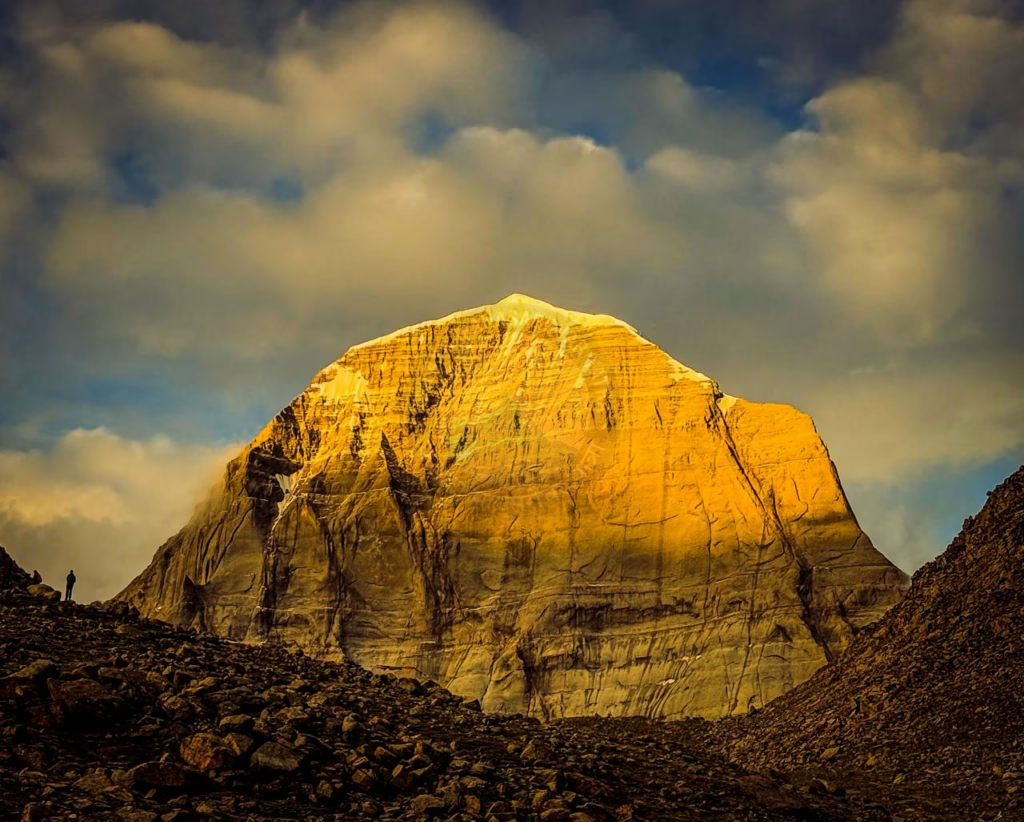
Kailash Mansarovar – Standing Before the Sacred Mountain
Imagine standing before Mount Kailash, its snow-clad peak piercing the sky with an authority that is neither loud nor demanding, but silent and eternal. The winds carry no noise, only whispers of forgotten ages. At its feet lies the crystalline Mansarovar Lake, shimmering under the Himalayan sun, a mirror of the heavens above.
This is not just geography; it is philosophy carved into stone and water. For millennia, sages, pilgrims, and wanderers have walked to this sacred confluence — to Kailash Mansarovar — not simply to see, but to awaken.
Why is it that certain landscapes stir the soul in ways no book, no teaching, no human voice can? Why are mountains like Kailash described not merely as landforms but as temples? And how is it that silence — the rarest commodity of our modern age — flows so abundantly here?
This article is not just a description of Kailash Mansarovar. It is an inner pilgrimage. Together, we will explore:
- The Himalayan philosophy of mountains as gods and temples of silence.
- The mythologies, Upanishadic reflections, and oral traditions tied to Kailash Mansarovar.
- How solitude in nature shifts human consciousness.
- Modern relevance: sustainability, ecology, spiritual tourism, and mindful travel.
- Interactive reflections, meditative practices, and stories that turn reading into an inner journey.
Let us begin not with a map, but with a question – When was the last time silence embraced you?
Find beautiful images of India’s touristic destinations here.
Kailash Mansarovar: Geography Woven with Myth
The Sacred Geography
Nestled in the Tibetan plateau, Mount Kailash rises 6,638 meters, an isolated pyramid of rock and snow, untouched by climbers. Just below it lies Lake Mansarovar, one of the highest freshwater lakes in the world, its name derived from the Sanskrit Manas (mind) and Sarovar (lake), literally meaning “Lake of the Mind.”
To geographers, this is simply the source of Asia’s great rivers — Indus, Sutlej, Brahmaputra, and Karnali. To spiritual seekers, it is the axis mundi, the navel of the universe, where earth, heaven, and the human spirit converge.
The Abode of Gods
In Hindu cosmology, Kailash is the dwelling of Lord Shiva, the yogi of yogis, who sits in eternal meditation. Tibetan Buddhism reveres it as the home of Demchok (Chakrasamvara), symbol of supreme bliss. Jains know it as Ashtapada, where Rishabhadeva attained liberation. Bon, the ancient faith of Tibet, regards it as the seat of spiritual power.
One mountain, many faiths — yet all converge on a single truth: this is a place where the human meets the infinite.
Mountains as Temples
Why Mountains Are Temples
Temples are not merely structures; they are spaces where the finite meets the infinite. But before stone temples existed, humans looked up at mountains. Their permanence, immensity, and stillness inspired awe.
The Rig Veda sings:
“The mountain stands firm, bearer of streams, giver of rest to the seer.”
Mountains are not built; they are revealed. They do not echo human voices; they resonate divine silence. Kailash Mansarovar embodies this philosophy: the Himalayas themselves are temples.
Silence as Architecture
In an urban temple, we see spires, domes, and rituals. In Kailash, the silence itself is the architecture. Silence here is not emptiness but fullness — filled with presence. Every gust of wind is a hymn; every reflection on Mansarovar is a mantra. To sit by Mansarovar is to enter a temple without walls.
The Inner Pilgrimage: Solitude and Consciousness
Solitude as Teacher
Modern life teaches us to avoid solitude, to drown in noise. Yet, at Kailash Mansarovar, solitude becomes the guru. There are no distractions, no markets of thought. Just you, the mountain, and the still lake. Solitude here reveals a paradox: the more alone you are, the more connected you feel.
The Shift in Consciousness
Pilgrims describe strange awakenings:
- A slowing down of thought — where mind mirrors Mansarovar, still yet alive.
- A softening of ego — under the gaze of Kailash, pride feels absurd.
- A sense of belonging — the universe does not feel vast and indifferent, but intimate.
This is why sages retreat to mountains: because silence is not absence, it is awakening.
Stories and Traditions of Kailash
Oral Traditions
Indian and Tibetan tribal pilgrims tell of mountains that “walked” into place, of lakes that formed from the tears of gods, of winds that carry the voices of ancestors. In Kumaon folklore, Kailash is called the “jewel of snow,” where every prayer uttered is amplified by the mountain’s silence.
Mythic Lessons
- Shiva’s Meditation: The stillness of Kailash teaches the stillness of meditation.
- Mansarovar’s Reflection: The lake reminds us that the mind, like water, must be clear to reflect truth.
- The Parikrama (Circumambulation): Walking around Kailash is seen as walking around the center of existence — a metaphor for circling the self until realization dawns.
Philosophical Reflections from Indian Thought
Upanishadic Wisdom
The Chandogya Upanishad says: “As is the microcosm, so is the macrocosm.”
Kailash embodies this teaching: the still mountain outside mirrors the stillness within.
The Mundaka Upanishad speaks of two birds on a tree — one eats, the other watches. At Kailash Mansarovar, one becomes the watcher, the silent witness to existence.
Vedantic Insight
Vedanta asks us: Who are you when all is silent? Kailash answers by stripping away noise. The mountain says nothing, yet everything.
The Practice of Presence at Kailash Mansarovar
Reflective Exercise – The Mansarovar Mirror
Sit quietly with a bowl of water before you. Watch your reflection. Notice how ripples distort it. Then let it still. This is the teaching of Mansarovar: clarity arises only in stillness.
Walking Meditation – The Inner Parikrama
Even if you never physically walk around Kailash, you can practice an inner parikrama. As thoughts arise, circle them gently, without judgment, until the ego dissolves and awareness expands.
Modern Relevance
Spiritual Tourism vs. Inner Transformation
In today’s world, Kailash Mansarovar attracts not only pilgrims but tourists. The risk: turning a sacred journey into a checklist. The call: to restore pilgrimage as inner transformation, not outer consumption.
Ecology and Sacredness
Himalayan glaciers are melting, rivers dwindling. To harm Kailash is not only ecological violence but spiritual harm. To protect Kailash is to protect the temple of silence itself.
Loneliness vs. Sacred Solitude
Modern cities are crowded yet lonely. At Kailash, solitude is not loneliness but communion. It teaches us how to be alone without being empty.
Interactive Reflections
- Close your eyes. Imagine standing before Kailash. What rises in you: fear, awe, or peace?
- Ask yourself: What is my Kailash? Which “mountain” in my life teaches me stillness?
- Write down: If silence were a teacher, what has it already taught me?
Becoming the Mountain
To journey to Kailash Mansarovar is to discover that the mountain is not outside you but within you. The real pilgrimage is not the miles walked but the silence entered.
The Himalayas teach:
- To rise high yet remain grounded.
- To endure storms yet remain still.
- To give rivers yet ask for nothing.
In the end, Kailash Mansarovar is less a destination and more a mirror. It reflects back not what you want to see, but who you truly are. The silence of the Himalayas is not absence — it is the presence of the eternal.