
Indian Architecture: More Than Just Stone
What if a building could change you? Not just shelter you from the rain or impress you with its beauty, but actually alter your state of consciousness? What if the very space you stood in was meticulously designed to quiet your mind, elevate your spirit, and guide you on an inward journey of self-discovery?
For centuries, Western architecture has largely prioritized form, function, and aesthetic appeal. But in India, for over two millennia, architecture has pursued a far more profound purpose: to serve as a catalyst for spiritual transformation and heightened inner awareness.
Indian architecture is not merely about constructing buildings; it is about crafting experiences. It is a sacred technology, a bridge between the material and the spiritual, designed using ancient cosmological principles to harmonize the individual with the universe. From the towering shikharas of temples that pierce the sky to the deep, introspective depths of stepwells, every element is intentional. Every proportion, every symbol, and the very play of light and shadow are orchestrated to facilitate a shift from outer distraction to inner peace.
This article is a deep dive into this extraordinary tradition. We will explore the philosophical foundations of Indian architecture, decode the sacred principles of Vastu Shastra, and journey through specific structures—temples, stepwells, ghats, and stupas—to understand how they function as machines for meditation and transformation. This is the story of how stone and spirit converge to shape human awareness.
The Philosophical Foundation – Vastu Shastra and the Cosmic Blueprint
To understand Indian architecture, one must first understand its foundational text: the Vastu Shastra (the science of architecture) and its companion, the Shilpa Shastra (the science of sculpture and iconography). These are not mere style guides; they are elaborate systems of knowledge that view the building as a living organism, a microcosm of the cosmic macrocosm.
The Concept of Vastu Purusha Mandala
At the heart of Vastu Shastra lies the Vastu Purusha Mandala. This is a sacred square grid that represents the cosmic being (Purusha) frozen in time, upon whom the building is constructed. Each square of the grid is governed by a different deity, representing a specific energy or aspect of the cosmos.
- Symbolism: The Mandala is a symbol of order imposed upon chaos. Building according to its principles is an act of aligning human dwelling with cosmic order (Rta).
- Practical Application: The most important zones are the center (Brahmasthana), which is always left open as a central courtyard or the sanctum sanctorum, and the northeast (Ishanya), which is considered the most auspicious direction for water and light. The placement of rooms, doors, and windows is meticulously planned to optimize the flow of positive energy (prana).
The Five Elements (Pancha Bhuta)
Indian architecture is deeply rooted in the balance of the five elements:
- Earth (Prithvi): The site selection is paramount. The soil is tested, and the land’s energy is felt.
- Water (Jala): Water bodies are strategically placed (especially in the northeast) for cooling, purification, and to attract positive energy.
- Fire (Agni): Represented by the sun’s path. Structures are oriented to harness optimal sunlight, with the kitchen (fire element) ideally placed in the southeast.
- Air (Vayu): Cross-ventilation is carefully designed to ensure a constant, gentle flow of fresh air.
- Space (Akasha): The most important element. The central Brahmasthana is left open to represent the space from which all creation emerges.
This holistic approach ensures that a structure isn’t just physically sound but is also a vibrantly healthy and energetically balanced entity.
The Temple – A Cosmic Mountain for Inner Ascent
The Hindu temple is the ultimate expression of Indian architecture‘s spiritual ambitions. It is not a congregational hall; it is a cosmic map and a vehicle for ascent.
The Symbolic Journey: From Bhuloka to Brahmaloka
A temple’s structure represents the journey from the material world to the realm of the divine.
- Garbhagriha (The Womb Chamber): The dark, cave-like sanctum sanctorum. It houses the main deity and symbolizes the unmanifest, the source of all creation. Its darkness forces the devotee to turn inward.
- Mandapa (The Hall): The porch or hall leading to the garbhagriha. It represents the world of manifestation, a transition space where one prepares to meet the divine.
- Shikhara/Vimana (The Spire): The towering peak over the garbhagriha. It represents the cosmic mountain Meru, the axis of the world, and the path to liberation (Brahmaloka). Its soaring height draws the eyes and the mind upward, toward transcendence.
Also read about the ancient city of Pragjyotishpur here.
Sacred Geometry and Proportion
Temples are built using precise geometric ratios (Ayadi calculations) derived from the supposed proportions of the universe.
- Mandala: The ground plan is always a Mandala, a perfect square symbolizing order and completeness.
- Yantra: The entire temple is a three-dimensional yantra—a geometric device for meditation. The complex patterns and concentric circles focus the mind and aid in concentration.
- Fibonacci Sequence: Ancient builders intuitively used harmonic proportions that resonate with natural growth patterns, creating a subliminal sense of beauty and order.
The Play of Light and Sound
- Light: The only light in the garbhagriha often comes from a single source—a lamp or a small opening—at a specific angle. This creates a dramatic play of light and shadow on the deity’s face at certain times of the day, making the experience dynamic and awe-inspiring. It represents the dawn of consciousness (Chaitanya) illuminating the darkness of ignorance.
- Sound: The temple is designed for acoustics. Chants and bells reverberate in a specific way, their vibrations (nada) intended to purify the atmosphere and the listener’s mind. The sound of Om chanting in a temple’s stone hall is an experience designed to resonate within the very bones of the devotee.
The Stepwell – Descending into the Subconscious
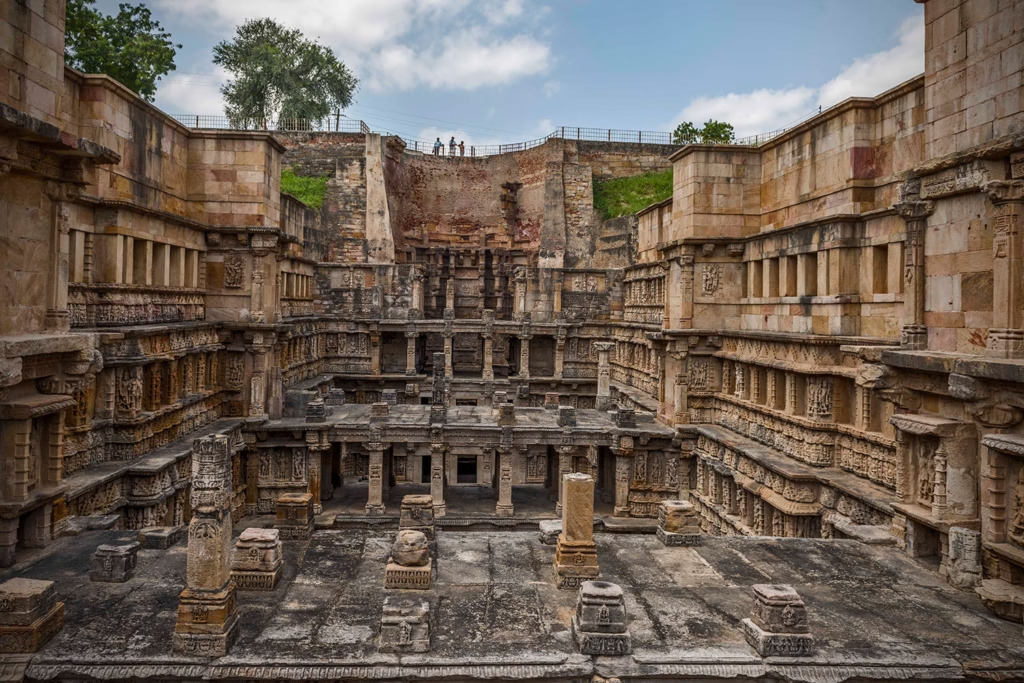
If the temple represents ascent, the stepwell represents descent. Structures like the magnificent Rani ki Vav in Patan, Gujarat, are masterpieces of Indian architecture that function as inverted temples.
Architecture of Descent and Return
The journey down a stepwell is a powerful psychological and spiritual metaphor.
- Descent: Walking down the intricate, symmetrical steps symbolizes a journey inward—away from the external world’s heat and chaos, into the cool, dark, tranquil depths of the subconscious mind.
- The Water: The water at the bottom represents the source of life, the subconscious itself, and the promise of purification and renewal.
- Ascent: The climb back up represents a return to the world, but reborn and refreshed, having touched the source. It is a architectural narrative of death and rebirth.
Every surface of Rani ki Vav is carved with hundreds of deities and mythological scenes. This ensures that even in the depths, the devotee is surrounded by sacred imagery, making the entire journey a contemplative pilgrimage.
The Ghats – Liminal Spaces of Life and Transition
The river ghats of cities like Varanasi are some of the most powerful examples of Indian architecture shaping daily life and awareness. They are liminal spaces—thresholds between land and water, life and death, the mundane and the sacred.
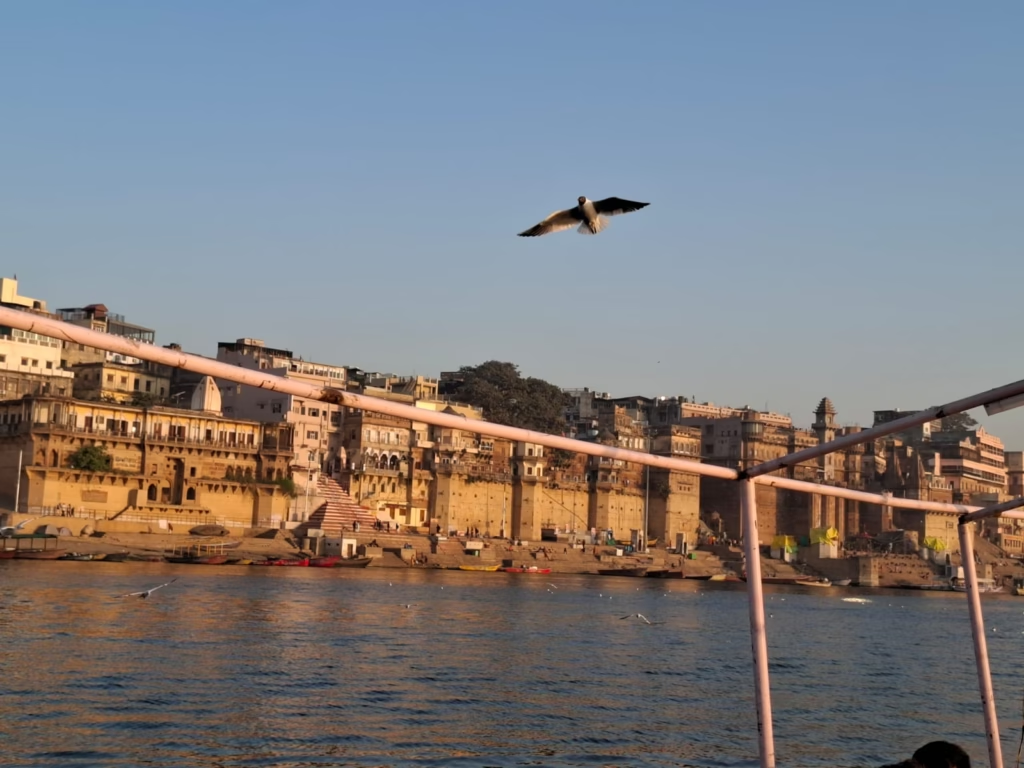
Source: Pixakunda.in, Find beautiful images of Indian Architecture and India’s touristic destinations here.
Ritual and Rhythm
The architecture of the ghats facilitates a rhythm of rituals that cultivate mindfulness.
- The Steps: The long, steep steps create a natural amphitheater for communal life and individual contemplation. Every dawn, thousands gather for the ritual bath, a physical act of purification that symbolizes the washing away of karma.
- The River: The flowing water of the Ganges represents the eternal flow of time and life (Pravritti). Immersion in it is an act of connecting with this eternal flow and surrendering the individual ego to the cosmic whole.
- The Ceremonies: The daily Ganga Aarti is a spectacular sensory spectacle of fire, sound, and smell. This collective ritual generates a powerful shared energy that elevates individual consciousness and fosters a profound sense of sacred participation.
The Stupa – The Enlightened Mind in Stone
Buddhist Indian architecture contributes the stupa, a perfect example of form following function for spiritual ends. The Great Stupa at Sanchi is a paradigm.
The Universe in a Dome
- The Hemispherical Dome (Anda): Represents the dome of the sky and the womb of the universe. It contains relics of the Buddha, symbolizing the enlightened mind present within all things.
- The Harmika: A square railing on top of the dome, representing the world of the gods or the higher states of consciousness.
- The Central Spire (Yasti): The axis rising from the harmika, symbolizing the axis mundi, the path to Nirvana.
- The Toranas: The four elaborately carved gateways mark the cardinal directions and depict stories from the Buddha’s life, serving as visual teachings.
The primary practice at a stupa is circumambulation (Pradakshina). Walking clockwise around the structure is a meditative practice that mimics the movement of planets. It symbolizes the path of life towards the central truth of enlightenment, helping to calm the mind and focus awareness.
The Jagannath Temple, Puri – A Universe of Compassion
The Jagannath Temple in Puri is a magnificent case study of how Indian architecture integrates symbolism, ritual, and space to create a transformative psychological environment.
- The Formless Deity: The idols of Jagannath, Balabhadra, and Subhadra are crudely carved, with large, staring eyes. This breaks the convention of idealized beauty and represents a formless, all-seeing divinity that transcends human aesthetics, fostering a sense of universal compassion and acceptance.
- The Chariot Festival (Ratha Yatra): This is architecture in motion. The massive chariots are moving temples. The ritual of pulling the gods through the streets signifies that the divine is not confined to the temple but is accessible to all, breaking down barriers of caste and creed.
- The Mahaprasad: The temple kitchen is the largest in the world. The act of sharing sanctified food (Mahaprasad) in a massive community feast dissolves ego and social hierarchy, creating a powerful psychological experience of unity and equality.
The Modern Relevance – Neuroscience and Sacred Space
Modern science is now catching up with ancient wisdom. Studies in environmental psychology and neuroscience confirm what Indian architects knew intuitively:
- Symmetry and Fractals: The complex fractal patterns and symmetrical designs found in temple carvings (like the infinitely repeating Kolam patterns) have been shown to reduce stress levels by up to 60% by positively impacting the brain’s visual cortex.
- Acoustics: The resonant frequencies found in chanting and temple bells can alter brainwave patterns, promoting states of calm and focus (alpha and theta waves).
- Awe: The sheer scale and grandeur of these structures induce a sense of awe, which psychologists have linked to greater life satisfaction, reduced materialism, and increased critical thinking.
Conclusion: The Living Stone
Indian architecture is a testament to a civilization that understood the deep dialogue between our outer environment and our inner world. These structures are not relics of a bygone era; they are living, breathing textbooks on consciousness.
They teach us that space matters. That the geometry of our surroundings can either agitate or calm our minds. That a journey through a thoughtfully designed space can be a journey into the deepest parts of ourselves.
From the soaring ambition of the temple to the introspective depth of the stepwell, this architecture invites us on a perpetual journey—from the outer world of stone and form to the inner world of spirit and awareness. It challenges us to build not just for the body, but for the soul, creating spaces that don’t just shelter us, but that truly shape us.