
Culture & Folk Culture

Assam Tea
Culture & Folk Culture, History & Conflict

The Amber Alchemist: Assam Tea and the Bitter-Sweet Taste of Enlightenment

The Amber Alchemist: Assam Tea and the Bitter-Sweet Taste of Enlightenment Read Post »

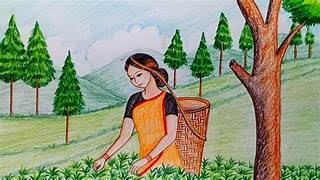
Assam Tea: A Universe in Your Cup Stop for a moment. Just stop. Look at the cup in your hand. Notice the colour—that deep, luminous amber, the colour of a sunrise over the Brahmaputra. Inhale its scent: malt, earth, a hint of distant woodsmoke. This is not just a beverage. This is a portal. For the true seeker, every object can be a guru, and every ritual a meditation. The humble leaf of Assam tea, Camellia sinensis var. assamica, is one of the most profound and overlooked teachers of our time. Its story is a grand epic—a saga of alchemical fire, colonial shadows, and the quiet, personal awakening that can happen at your kitchen table at 6 a.m. This is an invitation to a different kind of tea ceremony. Not one of rigid formality, but of deep inquiry. We will journey together into the heart of this brew – the Assam Tea, exploring its transformation as a mirror for our own, confronting the difficult history steeped in its leaves, and understanding how its very taste can alter our state of consciousness. Prepare to meet your Assam tea not as a consumer, but as a student. The Alchemy of the Leaf – Nigredo, Albedo, Rubedo in a Tea Factory To look at a plump, Assam tea green leaf on the bush is to see pure potential. Its journey to your cup is a perfect, almost sacred, alchemical operation. The medieval alchemists of Europe sought to transmute base lead into spiritual gold, a process they described in three key stages: Nigredo, Albedo, and Rubedo. Astonishingly, the processing of Assam black tea follows this very map of transformation. The Nigredo: The Blackening – Withering and Rolling The freshly plucked leaf, vibrant with life, is laid out to wither. It loses its water, its vitality, its green identity. It becomes limp, despairing. Then comes the rolling—a violent, brutal crushing that breaks its cellular walls, exposing its inner essence to the air. In alchemy, Nigredo is the first stage: the blackening, the putrefaction, the descent into darkness and chaos. It is the “Dark Night of the Soul.” The alchemist understood that to create something new, the old must first be broken down. As Carl Jung interpreted, this is the stage of confronting one’s shadow, of acknowledging the fragmented, messy parts of the self. The Assam tea leaf does not resist this. It surrenders. In its crushing, it releases the enzymes that will become its new soul. We, too, must often be broken open—by loss, by failure, by the sheer weight of life—to release the dormant potential within. The bitterness we taste later? It is the memory of this necessary rupture. The Albedo: The Whitening – Oxidation Now, the bruised and broken leaves are left in a controlled environment to oxidize. They turn from green to a bright, coppery brown. This is not a decay, but a ripening. The inner chemistry of the leaf transforms, developing the complex flavours and aromas we cherish. This is Albedo—the whitening. Following the blackness of Nigredo comes a purification, a washing, a whitening. In the human journey, this is the dawn after the dark night. It is the clarity that emerges from despair, the moment we begin to make sense of our suffering. The Assam tea leaf, in its patient surrender, is being purified, its true character emerging from the chaos. It is a stage of lunar reflection, of receiving insight. The Rubedo: The Reddening – Firing The final, crucial stage is firing. The oxidized leaves are subjected to intense heat, which halts the enzymatic process, locks in the flavour, and turns the leaves their characteristic dark black. This is Rubedo—the reddening. The final stage of the Great Work. It represents the culmination, the achievement of the philosopher’s stone, the integration of the self. The heat of the fire is not destructive, but definitive. It stabilizes the transformation. For us, this is the moment of integration, where our lessons learned, our sufferings processed, become a stable and enduring part of our character. The tea leaf is now complete. It has been through its own personal hell and heaven and emerged as a vessel of golden wisdom. The cup of Assam tea you hold is not a drink. It is a captured alchemical process. You are drinking the solidified journey of transformation. Read about the nutritional power of star fruit here. The Shadow in the Cup But we cannot speak of this spiritual alchemy without turning over the stone and looking at what crawls beneath. The romantic, philosophical narrative of tea exists in stark tension with its history. The very term “Assam Tea” is inextricably linked to the machinery of the British Empire. The Colonial Plantation: A Different Kind of Nigredo While the Assam tea leaf underwent its symbolic Nigredo, the people cultivating and processing it were often living a very real, very literal one. The establishment of tea plantations in Assam in the 19th century was an act of colonial extraction. Vast tracts of land were appropriated, and a system of indentured labour was established, moving Adivasi (tribal) communities from central India under often brutal and deceptive conditions. Their “Nigredo” was one of displacement, cultural rupture, and back-breaking labour for meagre wages. The shadow of this history still lingers in the socioeconomic structures of the region. The “briskness” of the tea, so prized by connoisseurs, can taste of the sweat and struggle of generations of plantation workers. So, we arrive at the difficult, essential question: Can the cup hold both enlightenment and the shadow of its production? This is not a question with an easy answer, and any spiritual path that ignores it is incomplete. To truly drink tea mindfully is to drink it with this awareness. It is to acknowledge the suffering embedded in its history and to inquire into its present. The spiritual response is not to reject the tea, but to consume it with sacred responsibility. It is to seek out ethically sourced, fair-trade brands that

Indian Architecture
Culture & Folk Culture, History & Conflict

From Stone to Spirit: How Indian Architecture Shapes Inner Awareness

From Stone to Spirit: How Indian Architecture Shapes Inner Awareness Read Post »

Indian Architecture: More Than Just Stone What if a building could change you? Not just shelter you from the rain or impress you with its beauty, but actually alter your state of consciousness? What if the very space you stood in was meticulously designed to quiet your mind, elevate your spirit, and guide you on an inward journey of self-discovery? For centuries, Western architecture has largely prioritized form, function, and aesthetic appeal. But in India, for over two millennia, architecture has pursued a far more profound purpose: to serve as a catalyst for spiritual transformation and heightened inner awareness. Indian architecture is not merely about constructing buildings; it is about crafting experiences. It is a sacred technology, a bridge between the material and the spiritual, designed using ancient cosmological principles to harmonize the individual with the universe. From the towering shikharas of temples that pierce the sky to the deep, introspective depths of stepwells, every element is intentional. Every proportion, every symbol, and the very play of light and shadow are orchestrated to facilitate a shift from outer distraction to inner peace. This article is a deep dive into this extraordinary tradition. We will explore the philosophical foundations of Indian architecture, decode the sacred principles of Vastu Shastra, and journey through specific structures—temples, stepwells, ghats, and stupas—to understand how they function as machines for meditation and transformation. This is the story of how stone and spirit converge to shape human awareness. The Philosophical Foundation – Vastu Shastra and the Cosmic Blueprint To understand Indian architecture, one must first understand its foundational text: the Vastu Shastra (the science of architecture) and its companion, the Shilpa Shastra (the science of sculpture and iconography). These are not mere style guides; they are elaborate systems of knowledge that view the building as a living organism, a microcosm of the cosmic macrocosm. The Concept of Vastu Purusha Mandala At the heart of Vastu Shastra lies the Vastu Purusha Mandala. This is a sacred square grid that represents the cosmic being (Purusha) frozen in time, upon whom the building is constructed. Each square of the grid is governed by a different deity, representing a specific energy or aspect of the cosmos. The Five Elements (Pancha Bhuta) Indian architecture is deeply rooted in the balance of the five elements: This holistic approach ensures that a structure isn’t just physically sound but is also a vibrantly healthy and energetically balanced entity. The Temple – A Cosmic Mountain for Inner Ascent The Hindu temple is the ultimate expression of Indian architecture‘s spiritual ambitions. It is not a congregational hall; it is a cosmic map and a vehicle for ascent. The Symbolic Journey: From Bhuloka to Brahmaloka A temple’s structure represents the journey from the material world to the realm of the divine. Also read about the ancient city of Pragjyotishpur here. Sacred Geometry and Proportion Temples are built using precise geometric ratios (Ayadi calculations) derived from the supposed proportions of the universe. The Play of Light and Sound The Stepwell – Descending into the Subconscious If the temple represents ascent, the stepwell represents descent. Structures like the magnificent Rani ki Vav in Patan, Gujarat, are masterpieces of Indian architecture that function as inverted temples. Architecture of Descent and Return The journey down a stepwell is a powerful psychological and spiritual metaphor. Every surface of Rani ki Vav is carved with hundreds of deities and mythological scenes. This ensures that even in the depths, the devotee is surrounded by sacred imagery, making the entire journey a contemplative pilgrimage. The Ghats – Liminal Spaces of Life and Transition The river ghats of cities like Varanasi are some of the most powerful examples of Indian architecture shaping daily life and awareness. They are liminal spaces—thresholds between land and water, life and death, the mundane and the sacred. Source: Pixakunda.in, Find beautiful images of Indian Architecture and India’s touristic destinations here. Ritual and Rhythm The architecture of the ghats facilitates a rhythm of rituals that cultivate mindfulness. The Stupa – The Enlightened Mind in Stone Buddhist Indian architecture contributes the stupa, a perfect example of form following function for spiritual ends. The Great Stupa at Sanchi is a paradigm. The Universe in a Dome The primary practice at a stupa is circumambulation (Pradakshina). Walking clockwise around the structure is a meditative practice that mimics the movement of planets. It symbolizes the path of life towards the central truth of enlightenment, helping to calm the mind and focus awareness. The Jagannath Temple, Puri – A Universe of Compassion The Jagannath Temple in Puri is a magnificent case study of how Indian architecture integrates symbolism, ritual, and space to create a transformative psychological environment. The Modern Relevance – Neuroscience and Sacred Space Modern science is now catching up with ancient wisdom. Studies in environmental psychology and neuroscience confirm what Indian architects knew intuitively: Conclusion: The Living Stone Indian architecture is a testament to a civilization that understood the deep dialogue between our outer environment and our inner world. These structures are not relics of a bygone era; they are living, breathing textbooks on consciousness. They teach us that space matters. That the geometry of our surroundings can either agitate or calm our minds. That a journey through a thoughtfully designed space can be a journey into the deepest parts of ourselves. From the soaring ambition of the temple to the introspective depth of the stepwell, this architecture invites us on a perpetual journey—from the outer world of stone and form to the inner world of spirit and awareness. It challenges us to build not just for the body, but for the soul, creating spaces that don’t just shelter us, but that truly shape us.

Sanatan Dharma
Culture & Folk Culture

Can Faith and Reason Coexist? How Sanatan Dharma Makes Spirituality Rational

Can Faith and Reason Coexist? How Sanatan Dharma Makes Spirituality Rational Read Post »

Also read about religiosity and wellbeing here. Sanatan Dharma & Spirituality We live in an age of intellectual polarization. On one side stands the fortress of rigid religion, often demanding blind faith, asserting dogma as absolute truth, and sometimes seeming to defy logic and scientific progress. On the other side stands the bastion of militant rationality, often dismissing all spiritual experience as delusion, reducing consciousness to mere neural chemistry, and leaving a void of meaning in its purely materialistic worldview. For the modern seeker, this creates a profound dilemma. The heart yearns for the sacred—for connection, purpose, and transcendence. Yet the mind demands evidence, coherence, and logical consistency. Must we choose? Must we sacrifice our intellect at the altar of faith, or abandon our spiritual longing in the name of reason? What if there is a third way? A path that does not just allow for both faith and reason but requires their synergy for one to walk it fully? This is not a new-age innovation. It is an ancient system of thought and practice, a sophisticated blueprint for human awakening known as Sanatan Dharma. Often colloquially called Hinduism, Sanatan Dharma translates to the “Eternal Order” or “Universal Law.” It is not a religion founded by a single prophet on a specific date. It is a vast, open-source framework of spiritual philosophy that has evolved over millennia, encompassing a breathtaking diversity of practices and beliefs, all united by a common core: the pursuit of truth (Satya) through experiential knowledge (Jnana). This article will explore how Sanatan Dharma elegantly bridges the perceived chasm between faith and reason. We will delve into its philosophical foundations, its practical pathways, and its timeless principles to understand how it doesn’t merely ask for belief but invites a rational, evidence-based investigation into the nature of reality and the self. This is the story of how spirituality becomes rational. The Philosophical Foundation – A Framework Built on Inquiry, Not Dogma The Core Metaphysics: A Rational View of Reality At its heart, the philosophy of Sanatan Dharma is built on a series of logical propositions about the nature of existence. These are not presented as articles of faith to be believed under threat of damnation, but as hypotheses to be contemplated, tested, and ultimately realized through direct experience. This entire metaphysical structure is rational and internally consistent. It provides a logical explanation for why we are here, why we suffer, and what our ultimate potential is. The Law of Karma: Ethical Cause and Effect Perhaps the most rational and empowering principle in Sanatan Dharma is the law of Karma. It is often misunderstood as fatalism, but it is precisely the opposite. Karma is the universal law of moral causation: every intentional action (karma) has a corresponding reaction or result (phala). Karma is a profoundly rational system of ethics that aligns with our innate sense of justice and is increasingly validated by modern psychology (e.g., the cycle of negativity breeding negativity) and systems theory. The Goal: Moksha Through Jnana (Liberation Through Knowledge) The ultimate goal in Sanatan Dharma is Moksha—liberation from the cycle of birth and death (Samsara) driven by Karma. Crucially, this liberation is not attained by pleading to an external god for salvation. It is attained through Jnana—knowledge. This is the ultimate synthesis of faith and reason. One has faith (Shraddha) that the teachings of the Rishis are a valid map. But one must then use reason (Buddhi) and direct investigation (Vichara) to realize the truth of the map for oneself. Moksha is the state of abiding in the knowledge “I am Brahman” (Aham Brahmasmi). It is not a belief; it is a direct, non-conceptual realization—the final piece of evidence that confirms the initial hypothesis. The Practical Pathways – The Yoga Systems: Rational Methods for Experiential Verification Philosophy is empty without practice. Sanatan Dharma provides a suite of practical, methodological pathways known as Yogas to test its philosophical hypotheses. Each Yoga is a science of inner experimentation. Jnana Yoga: The Path of Rational Inquiry This is the most direct path for the intellectual. Jnana Yoga is the systematic use of reason to discriminate (Viveka) between the real (Brahman) and the unreal (everything else). Its primary tool is the practice of Neti, Neti (not this, not this). The seeker inquires: “Who am I?” Raja Yoga: The Science of Mind Outlined by Patanjali in the Yoga Sutras, Raja Yoga is an eight-limbed (Ashtanga) system for mastering the mind. It is a step-by-step, replicable methodology: This is not based on faith. It is a practical manual. The “faith” is simply the willingness to try the experiment. The “proof” is the resulting state of peace, clarity, and expanded awareness. It is a science of consciousness. Bhakti Yoga: The Logic of the Heart Bhakti, or devotion, may seem like the domain of pure faith. Yet, even here, Sanatan Dharma provides a rational structure. Bhakti is not about blind belief in a deity. It is a psychological process of channeling and purifying emotions. Karma Yoga: The Yoga of Selfless Action Karma Yoga is the path of renouncing the fruits of action, not action itself. It is a profound psychological re-engineering. The Toolkit for the Modern World – Applying Sanatan Dharma Today The rationality of Sanatan Dharma is proven by its profound relevance to modern dilemmas. Find beautiful images of India’s touristic destinations here. Navigating Modern Ethical Challenges with Dharma Dharma is not a rigid list of commandments. It is context-sensitive duty. It requires rational discernment (Viveka) to apply eternal principles (like Ahimsa – non-harm, and Satya – truth) to modern contexts like digital ethics, environmental policy, and bioethics. It provides a framework, not an answer, demanding thoughtful engagement from the individual. Science and Sanatan Dharma: A Converging Dialogue The philosophical conclusions of Sanatan Dharma have fascinating parallels with modern science: Sanatan Dharma does not conflict with science; it invites a science of consciousness to complement the science of matter. Conclusion: The End of the Conflict So, can faith and reason coexist? Sanatan

Kamakhya
Culture & Folk Culture, History & Conflict

Kamakhya: Where Historicity Meets Awakening – The Unbroken Thread of Tantric Wisdom

Kamakhya: Where Historicity Meets Awakening – The Unbroken Thread of Tantric Wisdom Read Post »

Introduction: The Living Pulse of an Ancient Tradition What if a single geographic location could serve as a perfect, unbroken bridge between a millennia-old past and a dynamically living present? What if the very soil beneath your feet was not just historically significant, but alive with a spiritual current so potent it promises transformation? Nestled atop the mystical Nilachal Hills in Assam, the Kamakhya Temple is not a relic frozen in time. It is a living, breathing epicenter of one of the world’s most profound and often misunderstood spiritual traditions: Shakta Tantra. This is not merely a place of worship; it is a vortex of energy, a university of consciousness, and a testament to a philosophy where the deepest metaphysical truths are realized not through mere intellectualization, but through direct, visceral action. For the seeker, the historian, and the philosopher, Kamakhya presents a unique paradox. It is a site of immense historicity, its origins etched in the pages of ancient Puranas and Tantras, yet its power is entirely experiential, available only to those who engage with its rituals. It champions a philosophy that does not deny the world but embraces it utterly, seeing the human body, its desires, and the natural cycles of the earth as the very means to liberation. This article is a journey into the heart of this enigma. We will unravel the historical and scriptural evidence that anchors Kamakhya in time, explore the radical philosophy it embodies, and understand the transformative actions—the rituals and meditations—that make this ancient wisdom a living path to awakening today. This is the story of how Kamakhya seamlessly weaves together philosophy and action, offering a timeless logic for holistic living. Find beautiful images of India’s touristic destinations here. The Scriptural Anchor – Kamakhya’s Historical and Mythological Bedrock The Mythic Origin: The Fall of Sati’s Yoni The historicity of Kamakhya is inextricably linked to one of the most foundational narratives in Shaktism: the story of Goddess Sati and Lord Shiva. The ancient texts, primarily the Kalika Purana (circa 10th century CE), detail the event that transformed the Indian subcontinent into a sacred geography. Sati, the daughter of King Daksha and an incarnation of the primordial Goddess Adi Shakti, self-immolated in protest of her father’s disrespect toward her husband, Shiva. Blinded by inconsolable grief and rage, Shiva roamed the universe with her corpse, his cosmic dance of destruction (Tandava) threatening to unravel creation itself. To pacify Shiva and restore cosmic balance, Lord Vishnu used his Sudarshan Chakra to dismember Sati’s body. Where her parts fell, 51 Shakti Peethas (seats of power) emerged. But Kamakhya is unique. It is here that Sati’s yoni (womb, vulva)—the creative matrix of all life—fell to earth. This event is not merely a mythological tale; it is a profound metaphysical statement. It marks the moment when the infinite, formless divine principle took a definitive, tangible form in the material world, sanctifying the very principle of creation and embodiment. The Textual Testimony: Ancient Scriptural Corroboration Kamakhya’s historical significance is validated by its extensive mention in a corpus of revered texts: This robust scriptural foundation moves Kamakhya from the realm of local folklore to a pan-Indian, historically documented spiritual center. Its continuous existence and worship serve as a living archive, preserving practices that are thousands of years old. The Philosophy of the Womb – Tantra’s Radical Embrace of Reality Beyond Idol Worship: The Aniconic Yoni Pitha The most striking philosophical statement Kamakhya makes is in its sanctum sanctorum. Unlike most Hindu temples, there is no anthropomorphic idol of the Goddess. Instead, the object of worship is a natural rock formation in the shape of a yoni, constantly moistened by an underground spring. This is not an absence; it is a profound presence. It represents a core Tantric philosophical principle: the divine is not separate from creation; it is creation. The Goddess is not a deity “out there” to be appeased; she is the very life force (Shakti) that pulses through every atom of the universe. By worshipping the yoni, the devotee venerates the source of all life—the creative, generative principle that gives birth to galaxies, ecosystems, and human beings. This aniconic form challenges conventional religious norms. It dissolves the dichotomy between the sacred and the profane, the pure and the impure. It declares that the physical body, its functions, and its desires are not obstacles to spirituality but are themselves sacred instruments for awakening. Also read about Arunachal Pradesh – The Land of the Dawn here. The Unity of Opposites: Shiva and Shakti in Tantric Cosmology Kamakhya’s philosophy is encapsulated in the divine union of Shiva and Shakti. Shiva represents pure, static, unchanging consciousness (Purusha). Shakti represents dynamic, creative, energetic matter (Prakriti). One cannot exist without the other. Consciousness without energy is inert; energy without consciousness is chaotic. The Kalika Purana describes Kamakhya with twelve arms and six-colored faces, seated on a lotus emerging from Shiva’s navel. This iconography is a visual metaphor for their inseparable union. Kamakhya Temple is the earthly seat where this cosmic union is most accessible. The rituals performed here are designed to replicate this union within the practitioner, balancing their own masculine and feminine energies (ida and pingala nadis) to awaken the dormant spiritual energy at the base of the spine—the Kundalini Shakti. The Mahavidyas: The Embodiment of Ultimate Wisdom Kamakhya is also the epicenter of the worship of the Ten Mahavidyas (the Great Wisdoms). These are ten distinct manifestations of the Divine Feminine, each representing a different aspect of reality—from the fierce, time-devouring Kali to the beautiful and sovereign Tripura Sundari. The philosophical genius of the Mahavidyas is that they represent the full spectrum of existence: love and terror, creation and destruction, beauty and grotesqueness. By worshipping them all within one complex, Kamakhya teaches that to know the divine fully, one must embrace all of life’s experiences without judgment. Spiritual awakening comes not from rejecting the world but from penetrating its illusions with wisdom (Vidya). The Logic of Action – Rituals as Pathways to

zubeen garg
Culture & Folk Culture

The Philosopher’s Voice: Deconstructing the Spiritual and Existential Universe of Zubeen Garg

The Philosopher’s Voice: Deconstructing the Spiritual and Existential Universe of Zubeen Garg Read Post »

Zubeen Garg, A Voice of Consciousness In the vast, often superficial landscape of popular music, where beats often overshadow meaning and hooks replace depth, the phenomenon of Zubeen Garg emerged not merely as an artist, but as a cultural seismograph and a spiritual cartographer. He was not just a voice that sang; he was a consciousness that inquires, laments, celebrates, and seeks. For millions, particularly in Northeast India and beyond, Zubeen was not an entertainer but a companion for the soul—a philosopher who used melody as his medium and rhythm as his rhetoric. To approach Zubeen Garg’s work as a mere collection of songs is to miss the point entirely. His discography is a sprawling, vibrant, and often chaotic atlas of the human condition. It maps the terrain of our deepest anxieties, our most fervent spiritual yearnings, our raging identity crises, and our quiet, intimate moments of love and loss. He stood at the crossroads of the ancient and the ultramodern, weaving the sacred threads of Assamese Borgeet and folk traditions with the raw, electric energy of rock, pop, and Sufi devotion. This article is an expedition into the heart of this artistic universe. We will move beyond the celebrity and the hit charts to engage with Zubeen Garg, the thinker. We will analyze his lyrics, deconstruct the spiritual resonance of his compositions, and situate his work within a larger philosophical context. This is an exploration of how a boy from Jorhat, Assam, became one of the most compelling voices questioning what it means to be human in a complex, fragmented world. Zubeen Garg’s Assamese Roots as a Philosophical Springboard To understand Zubeen’s philosophy, one must first appreciate his cultural soil. Assam, with its history of resilient kingdoms, its syncretic culture blending Tantric, Vaishnavite, and tribal traditions, and its persistent struggle to maintain its identity, provides the fundamental dialectic of his work: Rootedness vs. Transcendence. The Echo of the Borgeet and the Bihu The Borgeet, devotional songs composed by Srimanta Sankardev and Madhavdev in the 15th-16th centuries, are not just religious hymns. They are profound philosophical treatises set to music, exploring the nature of reality (Brahman), the illusion of the world (Maya), and the soul’s longing for union with the divine. This tradition instilled in Assamese culture a deep-seated inclination for spiritual inquiry through artistic expression. Conversely, Bihu, with its unrestrained celebration of nature, fertility, and the agrarian cycle, represents a philosophy of immanence—finding the divine in the earth, the body, and the joy of the present moment. Zubeen Garg’s genius was in his ability to hold these two poles in creative tension. His music was often a conversation between the transcendent yearning of the Borgeet and the earthly, pulsating energy of Bihu. This duality forms the bedrock of his existential explorations: How do we reconcile the soul’s desire for the infinite with the body’s anchor in a specific time, place, and culture? A Taxonomy of Zubeen’s Songs’ Philosophy Zubeen’s work can be organized around several core philosophical themes that recur like leitmotifs throughout his career. Read about the 5 best Assamese movies of all time here. “Who Am I and Why Am I Here?” This was the most prominent theme in his oeuvre. Zubeen Garg was a quintessential existential artist, grappling with the fundamental anxiety of existence. He did not offer easy answers; he articulated the question with a rawness that is both unsettling and cathartic. His song- “Ei Prithibi” (This World) This song is a masterpiece of existential angst. The lyrics are a series of piercing questions directed at the cosmos: The music complements this perfectly. It often begins with a sparse, melancholic melody, building into a powerful, almost angry rock anthem. This musical journey mirrors the internal process of existential inquiry: starting with quiet confusion, moving through furious questioning, and arriving at a state of resigned, if not peaceful, acceptance of the mystery. Zubeen’s stance here was deeply aligned with thinkers like Albert Camus. He confronts the “absurd”—the futile search for meaning in a silent universe. His refusal to provide a comforting theological or philosophical answer is, in itself, a philosophical position. He invites us to be brave enough to live without definitive answers, to find our own meaning within the beautiful, terrifying silence. The Metaphor of the Caged Bird – The Quest for Authenticity The struggle between individual freedom and societal constraint is a universal human experience, but Zubeen gives it a uniquely potent voice, often through the metaphor of the bird. His song – “Pakhi” (The Bird) “Pakhi” is arguably Zubeen’s most profound philosophical statement. The song is a poignant dialogue with a bird, which symbolizes the unbound spirit, the authentic self, or pure consciousness. The “cage” represents everything that confines us: social expectations, dogma, political oppression, and the internal prisons of our own fear and conditioning. Zubeen didn’t just sing about the bird’s desire for freedom; he becomes the bird through his soaring vocals and the song’s liberating melody. The music itself is an act of breaking free. This theme resonates strongly with the works of Jiddu Krishnamurti, who spoke endlessly about freedom from the known—from the conditioning of the mind. “Pakhi” is a musical rendition of this very idea. The search isn’t for a geographical location but for a state of being—an authenticity where one’s inner and outer lives are in harmony. Spiritual Longing – The Sufi’s Heart in a Modern World While Zubeen Garg had been critical of organized religion, Zubeen’s work is saturated with a deep, authentic spirituality. His devotion is not ritualistic; it is a raw, personal, and often desperate cry for connection with a higher power. This is where his connection to Sufism becamemost evident. His song – “Ya Ali” Although from the Bollywood film Gangster, “Ya Ali” was a perfect window into Zubeen’s spiritual heart. The song is a qawwali-inspired plea to Imam Ali, a central figure in Sufism revered as a gateway to divine knowledge. Zubeen Garg’s own Assamese devotional songs, like those in the album

millet
Culture & Folk Culture

“Millet”, The Sacred Grain: Tribal Wisdom & Spiritual Philosophy

“Millet”, The Sacred Grain: Tribal Wisdom & Spiritual Philosophy Read Post »

Millet as Sacred Companion In the semi-arid hills and plateaus of India, for countless generations, millet was not merely a cereal—it was sacred companion, anchor, offering, identity. For tribes like the Kutia Kondh (Odisha), Nyishi (Arunachal), Baiga, Gond, and many others, millets such as pearl millet, finger millet, foxtail millet, kodo millet, barnyard millet form an ancestral, spiritual ecology. A 2025 review in Journal of Ethnic Foods affirms that millets have been embedded in religious ceremonies, folktales, ethnic cuisines, and rituals from the Vedic era through medieval India. In tribal festivals, millets carry memory—not just nutrients—connecting body, soil, lineage, and cosmos. This post will explore each millet variety through philosophical, tribal, meditative and ecological lenses – drawing on Upanishadic wisdom, tribal oral traditions, modern sustainability, and mindful eating practices. Pearl Millet (Bajra) – Resilience in Ritual and Rootedness Tribal Significance Pearl millet (bajra) is a hardy rain-fed crop often grown by the Baiga and Gond tribes in central India. The Baiga, who reject ploughing to honor “Mother Earth,” cultivate kodo millet and bajra through shifting agriculture, eating it as their staple and offering it in rituals. In Odisha’s Kutia Kondh tribe, for example, the festival Burlang Yatra is built around seed exchange, temple dances, and millet offerings—a collective effort that revived twelve millet varieties from memory and preserved them for future generations. Similarly, the Nyishi of Arunachal offer a fermented millet drink (Madua Apong) to their deity—a sacred gesture linking crop and cosmos. Storytelling Through Seed and Song In many tribal oral traditions, women as seed-keepers play poetic roles. They share millets in songs, weave stories, crown brides with millet paste (e.g., Korwa in Chhattisgarh), and preserve biodiversity through intercropping . These practices weren’t agricultural—they were spiritual. Each grain carried memory, identity, and ethics. Take the Taittiriya Upanishad, which teaches: “Never scorn food… share food with everyone… food is founded on food.” Food becomes not just nourishment—but a relation to Earth, Self, and community. Likewise, mitāhāra (moderate, pure eating) emerges in texts like the Hatha Yoga Pradipika and Śāṇḍilya Upaniṣad, emphasizing that diet is both physical and subtle: too much or impure food clouds the mind and spirit. Vedantic Reflection The Taittiriya Upanishad teaches: “Never scorn food… share food with everyone… food is founded on food.” Here, bajra porridge becomes more than sustenance—it is prasad, mutual becoming, shared divinity. In Śāṇḍilya Upanishad, mitāhāra (moderate, pure eating) is lauded—bajra, simple and pure, fits the sattvic ideal. Modern Relevance Pearl millet’s drought resistance makes it vital in India’s climate crisis adaptation. It uses far less water than paddy or wheat. Sustainably cultivating bajra revives tribal food security, counters malnutrition, and nurtures ecological balance. Finger Millet (Ragi/ Mandua) – Nourishment and Ritual Tribal Stories In Arunachal Pradesh, tribes like the Adi, Nyishi, Monpa and Idu Mishmi prepare finger millet (ragi) in multiple ways—from pancakes to porridges, and fermented brews like Apong during festivals. A 2024 ethnobotanical study of Nepalese and Indian traditions describes how finger millet is offered at ancestral shrines, used in wedding ceremonies, and as sacred food in life-cycle events. Spiritual Philosophy In the Chandogya Upanishad (6.5), food is explained as transforming into body, mind, prāṇa (vital life). This is not metaphor—it’s ontological. The food we choose is what we become, from tissue to tone. This aligns with tribal millet practices. When millet is offered as prasad, eaten during birth ceremonies, weddings, or death rites, it’s more than nutrition—it is ancestral communion. Moreover, millets embody the sattvic ideal in Yogic diet: natural, pure, life-affirming, nonviolent Mindful Eating Practice Prepare ragi kheer: slow cook finger millet with water/milk, add jaggery and cardamom. Sit alone. Before eating, close eyes and breathe. As you sip each spoonful, feel warmth and sweetness merging with awareness. Eat silently—taste lineage. Nutritional & Ecological Value Finger millet is rich in calcium, iron, fiber, and essential amino acids. Unlike wheat and rice, it helps regulate blood sugar and supports bone strength. Its cultivation supports biodiversity and low-input rain-fed farming. Foxtail Millet (Kangni) – Cultural Celebrations & Communal Living Tribal Use & Ritual Foxtail millet is common in central and southern tribal regions. In Odisha’s Burlang Yatra, kangni is one of several millets exchanged and prayed over. Among the Mizo and Naga tribes, millet dishes mark pre-harvest festivals (Thalfavang Kut, Te-l Khukhu) as offerings of gratitude. The Naga festival Te–l Khukhu (Nagaland) is based on a legend where a toad brings millet to a girl—and millet is offered annually in celebration—a living myth linking nature, gratitude, and millet. Vedantic Lens Vedanta emphasizes krishna → kṛṣṇa (plough) and anusandhana (attention) in every act. Growing kangni, harvesting it in community, and cooking it gratefully becomes yoga—unified labor, devotion, celebration. Ecological & Health Insights Foxtail millet is resilient, nutritious, and adaptogenic to poor soils and low rainfall—making it ideal for tribal ecological zones. Kodo Millet – Endurance & Earth-Respecting Cultivation Tribal Wisdom Kodo millet thrives on poor, rocky soils in central India. The Baiga and Gond cultivate it through shifting agriculture without ploughing—honoring the Earth as Mother. In Chhattisgarh, the Korwa women mix kodomillet paste into brides’ crowns & blessings. Spiritual Depth This tribe’s worldview is deeply animistic—the seed is life, the soil is mother, the act of cropping is sacred covenant. Eating kodomillet is embodying a pact of reciprocity with Earth—not extraction, but humble partnership. Modern Relevance Kodo millet’s resilience is crucial for climate-smart agriculture. It helps degraded lands recover, prevents soil erosion, and preserves food sovereignty for tribal farmers. Barnyard Millet – Festivals & Ecology Tribal & Regional Use Barnyard millet (sawan/jhangora) is grown in eastern India and the Himalayas. Among tribal communities like the Baiga and Hill Miri, it’s used in porridges, breaths, and local brews (opo). In Odisha, barnyard millet sweets and offerings are essential in Nuakhai—a festival of the first grain—creating communal unity. Philosophical Perspective Barnyard millet reminds us of alamkara (ornament) in spiritual texts—food becomes ritual beauty. In Upanishads, first fruits and grains are presented to gods, ancestors, then consumed—a procession of respect. Barnyard millet is

religiosity
Culture & Folk Culture

Does Religiosity Enhance Well-Being? – The Philosophical Underpinning

Does Religiosity Enhance Well-Being? – The Philosophical Underpinning Read Post »

Religiosity and Wellbeing Religion is as old as the human civilization. These are just like the peanut butter and the jam – two inseparable duo we can’t help but remain fascinated about. From the dawn of humanity when our forefathers fathomed about the mysteries of human life while gazing the stars, religion guided them at every step. If we imagine our great, great ancestors experiencing the thunderstorms from their cages or the flickering fire rising up high, they must have pondered upon the first seeds of religion. “Must be someone high up in the skies, some power, powerful than us” – the first chat of the Homo sapiens about divinity. And this continued millennia after millennia, as religion integrated further into the very discussions and fabric of the human civilizations. We see it colouring every aspect of our lives – morality, lifestyles, arts, politics and our personal identity as well. Religion served as the cannon to answer the queries of all times. Why do we exist? What is our purpose? Why we are here? Who is responsible for the weather? Who makes the winds and the rains? Why do we die? What happens when we die? Etc. etc. Take for instance the Greek civilization. Their Gods are intriguing dipped in romantic opera – Venus and Mars caught in a net, Attis and Cybele’s bond of passion and divine significance. The afterlife concept of ancient Egypt is a fascinating tale where even the dead are treated with pleasures and pearls; Hinduism’s departmental division of the Gods as the creator, destructor and caretaker of the world, and where Saraswati holds the division of education, while Laxmi bestows wealth. Religion has remained humanity’s moral compass with commandments, teachings and tenets. These beliefs and practices found in Christianity, Buddhism and Islam aren’t just religious doctrines but are the ancient versions of the self-help books that guide people about how to live well and treat others kindly. Even the most atheist would also seek little divine intervention when the going gets tough. “Oh Lord! Where did I lose my keys? Help me find my marriage ring”. That belief in something over there greater than ourselves is the comforting corner of religiosity for our wellbeing. Scholars suggest that religion cultivates social networks, gives meaning to life, inculcates healthy lifestyle choices. However, in modern times where there is the rise of secularism and growth of spirituality outside traditional frameworks, defining the relationship between religiosity and our wellbeing is the question we confront. People may not have a strong definition about religion but meditate with apps on their phones. Meditation becomes their religion which defines their wellbeing and purpose in life. Hence, religiosity and wellbeing are intertwined in complex and fascinating ways. The Empirical Evidence on Religiosity and Wellbeing Empirical evidence suggests that religiosity and well-being are like Fred Astaire and Ginger Rogersinter (dance partners in Hollywood movies), always in sync and impressively graceful. Many studies suggest that people who involve themselves in regular religious practices report higher levels of satisfaction. It’s as if getting life time access to a health app with less subscription fees. It’s not astonishing to see why individuals having memberships in meditation gurukuls have a robust social network. Aristotle’s idea of eudaimonia, where wellbeing is about strong social bonds achieved through virtuous activities, is a perfect sync. Wouldn’t be wrong to say that divine dinners in community gatherings help stay mentally healthy. Pew Research Centre study also highlights the positive relation between religious individuals and their lesser stress and anxiety levels. Regular meditative practices and prayers provide a sense of peace and purpose, acting like a spa treatment for many individuals. It’s no wonder that worries about bills and work deadlines and tension regarding branded choices, all melt away in the bright light of spiritual fulfilment. While extrinsic religiosity gives bliss, some research reports state that intrinsic religiosity is more fulfilling even without any social perks or community meals. Existentialist philosopher Søren Kierkegaard would approve this philosophy while chuckling at the notion of faith being reduced to a mere membership club. Afterall, authenticity of belief and one’s engagement in purpose of life is paramount. Religiosity and Wellbeing – The Other Side Though studies point towards higher life satisfaction with religiosity, not all is sunshine and hymns. High dogmatism or fundamentalism can increase stress and anxiety level decreasing the wellbeing. Faith, when it turns into a source of division rather than unity, can negate all benefits. Religiosity is synonymous to the chocolate cake that is best enjoyed when taken in balanced portions. Just as too many inspirational or self-help books can leave you confused; overzealous religiosity can become the brakes in life. Imagine attending weekly sermon lessons only to know that whatever we are doing is all wrong. Isn’t it like perpetually getting stuck in a traffic without any clue of what’s ahead? Strict doctrines can sometimes become an oppressive script, frustrating and draining our lives. The existentialist argues that when religion becomes the source of fear, it overrides the true meaning of life. Extreme religiosity can make many people feel like Greek King Sisyphus eternally lifting the boulder to the mountain top. It also lowers self-esteem and increases depression, especially in those individuals who happen to frequently engage in guilt-tripping sessions. It activates the inner critic within that constantly demoralizes the soul by pointing out the faults. Philosopher Nietzsche, the critic of culture, would literally smirk thinking how guilt can be a potent weapon to constrain a human spirit rather than elevating him from the contexts of good and evil. Added to this is the community pressure that coerce kith and kins into practicing religiosity thereby decreasing the overall happiness of otherwise free-spirited beings. Rightly demonstrated by Focault that social control can become invisible chains subtly stifling individuals free thinking and well-being. Sometimes the serene activity of praying can also backfire. Coerce any child absorbed in a computer game to pray and see what happens. The fear of divine retribution only makes

Scroll to Top