
Introduction: The Living Pulse of an Ancient Tradition
What if a single geographic location could serve as a perfect, unbroken bridge between a millennia-old past and a dynamically living present? What if the very soil beneath your feet was not just historically significant, but alive with a spiritual current so potent it promises transformation?
Nestled atop the mystical Nilachal Hills in Assam, the Kamakhya Temple is not a relic frozen in time. It is a living, breathing epicenter of one of the world’s most profound and often misunderstood spiritual traditions: Shakta Tantra. This is not merely a place of worship; it is a vortex of energy, a university of consciousness, and a testament to a philosophy where the deepest metaphysical truths are realized not through mere intellectualization, but through direct, visceral action.
For the seeker, the historian, and the philosopher, Kamakhya presents a unique paradox. It is a site of immense historicity, its origins etched in the pages of ancient Puranas and Tantras, yet its power is entirely experiential, available only to those who engage with its rituals. It champions a philosophy that does not deny the world but embraces it utterly, seeing the human body, its desires, and the natural cycles of the earth as the very means to liberation.
This article is a journey into the heart of this enigma. We will unravel the historical and scriptural evidence that anchors Kamakhya in time, explore the radical philosophy it embodies, and understand the transformative actions—the rituals and meditations—that make this ancient wisdom a living path to awakening today. This is the story of how Kamakhya seamlessly weaves together philosophy and action, offering a timeless logic for holistic living.
Find beautiful images of India’s touristic destinations here.
The Scriptural Anchor – Kamakhya’s Historical and Mythological Bedrock
The Mythic Origin: The Fall of Sati’s Yoni
The historicity of Kamakhya is inextricably linked to one of the most foundational narratives in Shaktism: the story of Goddess Sati and Lord Shiva. The ancient texts, primarily the Kalika Purana (circa 10th century CE), detail the event that transformed the Indian subcontinent into a sacred geography.
Sati, the daughter of King Daksha and an incarnation of the primordial Goddess Adi Shakti, self-immolated in protest of her father’s disrespect toward her husband, Shiva. Blinded by inconsolable grief and rage, Shiva roamed the universe with her corpse, his cosmic dance of destruction (Tandava) threatening to unravel creation itself. To pacify Shiva and restore cosmic balance, Lord Vishnu used his Sudarshan Chakra to dismember Sati’s body.
Where her parts fell, 51 Shakti Peethas (seats of power) emerged. But Kamakhya is unique. It is here that Sati’s yoni (womb, vulva)—the creative matrix of all life—fell to earth. This event is not merely a mythological tale; it is a profound metaphysical statement. It marks the moment when the infinite, formless divine principle took a definitive, tangible form in the material world, sanctifying the very principle of creation and embodiment.
The Textual Testimony: Ancient Scriptural Corroboration
Kamakhya’s historical significance is validated by its extensive mention in a corpus of revered texts:
- The Kalika Purana: This is the most crucial text for Kamakhya. It explicitly identifies the Nilachal Hill as the site of the fallen yoni, establishing it as the supreme Shakti Peetha (Maha Peetha). It provides detailed descriptions of the region, the temple, and its rituals, offering a historical blueprint of its importance.
- The Devi Bhagavata Purana: This text further glorifies the Goddess and her various abodes, reinforcing Kamakhya’s status among the most important centers of Shakti worship.
- The Yogini Tantra and Hevajra Tantra: These Tantric texts delve into the esoteric aspects of worship at Kamakhya, outlining sophisticated rituals and meditative practices. They position the temple as the central hub for Tantric sadhana (spiritual practice), attracting seekers from across the Indian subcontinent and beyond for centuries.
This robust scriptural foundation moves Kamakhya from the realm of local folklore to a pan-Indian, historically documented spiritual center. Its continuous existence and worship serve as a living archive, preserving practices that are thousands of years old.
The Philosophy of the Womb – Tantra’s Radical Embrace of Reality
Beyond Idol Worship: The Aniconic Yoni Pitha
The most striking philosophical statement Kamakhya makes is in its sanctum sanctorum. Unlike most Hindu temples, there is no anthropomorphic idol of the Goddess. Instead, the object of worship is a natural rock formation in the shape of a yoni, constantly moistened by an underground spring.
This is not an absence; it is a profound presence. It represents a core Tantric philosophical principle: the divine is not separate from creation; it is creation. The Goddess is not a deity “out there” to be appeased; she is the very life force (Shakti) that pulses through every atom of the universe. By worshipping the yoni, the devotee venerates the source of all life—the creative, generative principle that gives birth to galaxies, ecosystems, and human beings.
This aniconic form challenges conventional religious norms. It dissolves the dichotomy between the sacred and the profane, the pure and the impure. It declares that the physical body, its functions, and its desires are not obstacles to spirituality but are themselves sacred instruments for awakening.
Also read about Arunachal Pradesh – The Land of the Dawn here.
The Unity of Opposites: Shiva and Shakti in Tantric Cosmology
Kamakhya’s philosophy is encapsulated in the divine union of Shiva and Shakti. Shiva represents pure, static, unchanging consciousness (Purusha). Shakti represents dynamic, creative, energetic matter (Prakriti). One cannot exist without the other. Consciousness without energy is inert; energy without consciousness is chaotic.
The Kalika Purana describes Kamakhya with twelve arms and six-colored faces, seated on a lotus emerging from Shiva’s navel. This iconography is a visual metaphor for their inseparable union. Kamakhya Temple is the earthly seat where this cosmic union is most accessible. The rituals performed here are designed to replicate this union within the practitioner, balancing their own masculine and feminine energies (ida and pingala nadis) to awaken the dormant spiritual energy at the base of the spine—the Kundalini Shakti.
The Mahavidyas: The Embodiment of Ultimate Wisdom
Kamakhya is also the epicenter of the worship of the Ten Mahavidyas (the Great Wisdoms). These are ten distinct manifestations of the Divine Feminine, each representing a different aspect of reality—from the fierce, time-devouring Kali to the beautiful and sovereign Tripura Sundari.
The philosophical genius of the Mahavidyas is that they represent the full spectrum of existence: love and terror, creation and destruction, beauty and grotesqueness. By worshipping them all within one complex, Kamakhya teaches that to know the divine fully, one must embrace all of life’s experiences without judgment. Spiritual awakening comes not from rejecting the world but from penetrating its illusions with wisdom (Vidya).
The Logic of Action – Rituals as Pathways to Awakening
Tantra is often called a “practical philosophy.” Its truths are not meant to be believed but to be experienced. The rituals at Kamakhya are the precise, refined actions designed to facilitate this direct experience.
The Ambubachi Mela: Sanctifying the Natural Cycle
The most famous ritual, the Ambubachi Mela, is a powerful example of philosophy in action. For three days, the temple doors are closed, symbolizing the annual menstruation of the Goddess. The earth itself is considered impure during this time, mirroring societal taboos.
But here, the action subverts the taboo. Instead of being hidden, this natural cycle is publicly sanctified. On the fourth day, the temple reopens, and the symbolic menstrual fluid—a combination of the water from the spring and red vermillion—is distributed as prasad (divine blessing) called Angodak (water from the body) and Angavastra (cloth from the body).
The Philosophical Action: This ritual is a profound act of reclamation. It:
- Elevates the Feminine: It declares female biology and its cycles as sacred, not shameful.
- Maps the Macrocosm to the Microcosm: The Goddess’s menstruation is linked to the fertile monsoon rains, connecting the human body to the rhythms of the earth.
- Teaches Acceptance: It forces the devotee to confront and honor a natural, powerful, and often stigmatized aspect of life, thereby breaking deep-seated conditioning.
Yoni Puja: The Direct Engagement with the Source
The central daily ritual is the worship of the yoni-shaped stone. Devotees offer flowers, red cloth (symbolizing fertility), and water to the moist cleft.
The Philosophical Action: This is not a passive prayer. It is an active meditation on origin and creation.
- Focusing the Mind: The unusual form prevents the mind from latching onto familiar imagery, forcing it into a state of focused curiosity.
- Invoking Creative Power: The offerings are made with the intention of awakening one’s own inner creative and spiritual potential (Kundalini).
- Dissolving Duality: By venerating the source of physical birth, the practitioner acknowledges the divinity of their own embodiment, erasing the false separation between spirit and matter.
Tantric Sadhana: Guided Transformation under the Aghoris and Tantriks
For the initiated, Kamakhya offers personalized Tantric sadhana under the guidance of experienced practitioners (Aghoris, Ojhas). This involves:
- Mantra Japa: Precise, powerful sound vibrations to attune the individual’s energy to the frequency of the Goddess.
- Visualization and Meditation: Guided practices to awaken specific energy centers (chakras) and channel the Kundalini.
- Esoteric Rituals: Complex ceremonies involving sacred geometry (yantras), gestures (mudras), and sometimes, regulated ancient practices to harness powerful energies for spiritual and worldly goals.
The Philosophical Action: This represents the ultimate synthesis of philosophy and action. The abstract concepts of Shiva-Shakti union, energy channels, and consciousness expansion are turned into a tangible, experiential reality through disciplined practice. The guru’s role is crucial—they are the living embodiment of the tradition, providing not just information but transmission.
The Enduring Legacy – Kamakhya’s Relevance for the Modern Seeker
The historicity of Kamakhya is not a closed chapter; it is an ongoing narrative. Its relevance for the modern seeker lies in its timeless, holistic answer to the human quest for meaning.
In a world grappling with ecological crisis, Kamakhya’s reverence for the earth’s cycles offers a model for sustainable living. In a world struggling with gender inequality, its worship of the Divine Feminine in her most powerful and primal form provides a paradigm for respect and balance. For the individual seeker feeling disconnected and anxious, its Tantric practices offer a concrete, embodied path to inner peace and self-realization.
The temple stands as a permanent invitation: to move beyond belief into experience, to embrace all of who we are, and to engage in the conscious action required to transform our consciousness. It proves that true philosophy is not just to be understood, but to be lived.
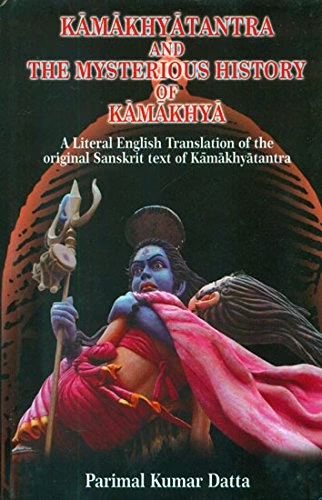
A Literal English Translation of the original Sanskrit text of kamakhyatantra.
Conclusion: The Unbroken Thread
The Kamakhya Temple is far more than a historical monument. It is a living laboratory of consciousness where the deepest philosophies of Tantra are translated into transformative action. Its historicity is validated by ancient texts, but its power is confirmed by the millions of devotees who have experienced its grace across centuries.
From the mythic fall of Sati’s yoni to the potent rituals of the Ambubachi Mela and the deep meditations on the Mahavidyas, Kamakhya presents a complete spiritual logic. It teaches that history is not a dead past but a living current, that philosophy is not an abstract theory but a manual for living, and that the ultimate goal of human life—awakening—is achieved not by escaping the world, but by plunging into its sacred heart with wisdom and courage.
For the true seeker on the path of philosophy and action, a journey to Kamakhya, whether physical or philosophical, is a journey to the very source of power, creativity, and liberation.